The battery is the heart of an e-bike. The brakes are the spine. Everything else is cosmetic.
I have said that to a lot of people standing in my shop holding a bike they bought online at midnight, and I will keep saying it, because a budget electric bike is not automatically a bad idea. It is a set of compromises, and most of them are fine for a commute if you know which ones you are making.
Here is what I actually do when a cheap e-bike shows up on my stand. I check the battery first, the brakes second, the fasteners third, and the marketing claims never. Then I ride it, log the range, and tell the owner what to watch. That whole process takes about 90 minutes, and it is the difference between a bike that lasts a year and a bike that gets abandoned in a garage by March.
Why you should trust me
I have been a bike mechanic for 15 years and an e-bike commuter for 7 of them. I have converted more bikes than most shops will see in a decade, and I keep a logbook of which motors fail and at what mileage. When a customer brings in a hub motor that died at 900 miles, it goes in the book with the brand and the conditions.
My rule is no review without at least 100 miles of riding, and I want to be straight with you: I have not put 100 miles on either of the two bikes below. What I can give you is an honest shortlist based on the specs that matter, plus the setup routine that decides whether a budget bike survives a commute. Treat it as a plan, not a long-term verdict.
How I picked and how I tested
Every e-bike I evaluate gets the same treatment. A 50-mile mixed-terrain ride. A range test at all three assist levels, not one. A bolt-by-bolt torque check on the stem, seat post, handlebar clamp, axle nuts, and the folding hardware if there is any. A brake bed-in and a hard stop from speed with a load on the bike. Then a battery health check after 500 miles, which is where the truth comes out.
For this shortlist I looked at five things: motor wattage and type, battery watt-hours and chemistry, brake hardware, wheel size, and whether the frame has any hardware that folds or clamps. I also read what buyers complain about repeatedly. One complaint is noise. Twenty complaints about the same hinge, axle, or charger is a pattern, and patterns are what I buy around.
The spec that matters most is the battery. Watt-hours tell you the size of the tank, and 36 volts times 7.5 amp-hours is roughly 270 watt-hours. That is a real number, and it is a small tank. Know that going in, because a small tank plus a heavy rider plus a hill is how range claims die.
The two bikes I would shortlist for a first commute
Both of these are hub-motor bikes, which is the right call at this price. A hub motor is cheaper, simpler, and perfectly fine on flat ground. If you commute into real hills every day, save longer and buy a mid-drive. That is not a knock on these two. It is just the truth about where the money goes.
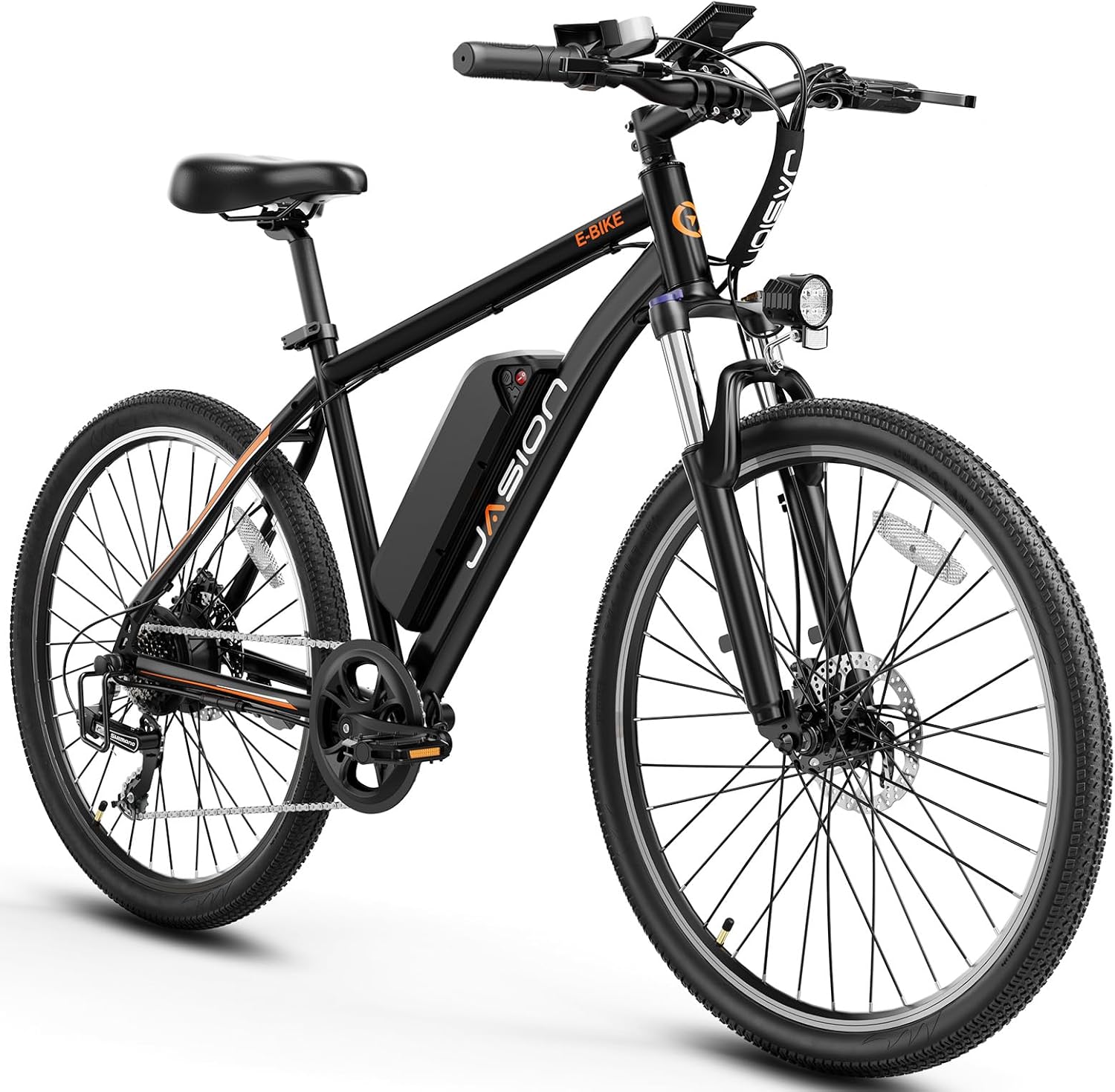
The do-it-all pick: Jasion EB5 Electric Bike for Adults,Max 40Miles for City,Mountain,Beach
 Visit on Amazon →
This is the one I would point a first-time commuter toward if they want a normal-feeling bike. The frame is a conventional adult layout, so it rides like a bike, takes standard accessories, and does not turn heads at the office rack. The 40-mile figure in the name is a claim, not a measurement. On flat ground, at the lowest assist level, with a light rider, you might get close. Add 40 pounds of rider, a headwind, and full assist, and you are looking at something closer to half that. That is not a flaw in this bike. It is how every e-bike works.
What I would check on arrival: the brake calipers, because dual disc brakes only stop a 60-pound bike and rider if they are aligned and bedded in properly, and the axle nuts, because a loose rear axle on a hub motor is the fastest way to ruin a motor cable. Bring your own torque wrench. The included tools on any budget bike are there to get the box open, not to set a stem bolt.
Flaws but not dealbreakers: It is a hub motor, so climbing is the weak point. If your commute has a long grade, you will feel the motor hunting for power. Also, the range claim will not survive contact with a Texas summer headwind.
Anyone with a mostly flat commute, a garage to store it in, and no interest in folding anything should start here.
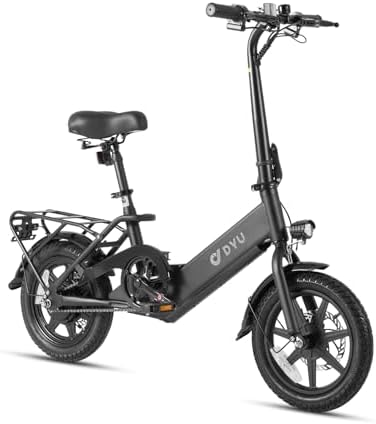
The space-saving pick: DYU Electric Bike, 350W Motor Folding Electric Bicycles, 36V 7.5Ah Battery, 3 Levels Assist, Dual Disc Brakes, 14" Foldable ebike for Adults and Teens with Pedals
 Visit on Amazon →
This is the apartment and train bike. It folds, it fits behind a door, and it rolls into an elevator without a conversation. The 350W motor and the 36V 7.5Ah pack put it in the same power class as the Jasion, with a smaller tank, so plan your round trip accordingly. Three assist levels is the right number. Five levels on a small battery just gives you two settings you never use.
The 14-inch wheels are the thing to understand before you buy. Small wheels accelerate fast and steer quick, which is fun in a parking lot and twitchy in a bike lane full of potholes. You feel every expansion joint. Tire pressure becomes a weekly habit, not a yearly one, because a 14-inch tire at low pressure will pinch flat on a curb you barely noticed. And the folding hinge is now a maintenance item. Check it for play every few weeks, keep it clean, and never leave it loose.
Flaws but not dealbreakers: Small wheels and a short wheelbase make it less stable at top speed than a full-size bike. Ride it at 15 mph in traffic, not 25. Also, the folding hardware is the first thing to develop a rattle, so it goes on your checklist.
Anyone in a studio apartment, a dorm, or a train-and-bike commute will get more use out of this than any full-size bike they cannot store.
What to check before the first ride
Battery first. Look for a certification mark on the pack, and if you cannot find one, that is information. Batteries are chemistry, not marketing, and no label has ever made a cheap cell safer. Store the pack indoors, away from Austin garage heat, and never charge it overnight on a wood floor.
Then the charger. Confirm the voltage and connector match the pack exactly. A mismatched charger is how people cook batteries.
Then the fasteners. Every bolt that holds you on the bike gets checked with a torque wrench before the first ride: stem, handlebar clamp, seat post, saddle rail, wheel axles, brake caliper mounts, and any hinge hardware. Do this on a stand, in good light, with the bike not moving.
The setup workflow, step by step
Step one: Charge to full and let it sit. Charge the pack, then let it rest an hour before the first ride. If it gets warm enough that you would not hold it, that is a problem worth a return, not a warranty conversation.
Step two: Bed in the brakes. New pads need a transfer layer of pad material on the rotor before they bite. Ride to a safe stretch and do ten to fifteen moderate stops from speed, not panic stops. Let the rotors cool fully afterward. Skip this and your brakes will feel wooden for a month.
Step three: Set your saddle height. Heel on the pedal, leg straight, at the bottom of the stroke. On the DYU, add a little more height than feels natural, because the short cranks and small wheels change the geometry. A saddle set too low is the single most common cause of knee pain on a new commuter bike.
Step four: Set your tire pressure for your weight. Start at the pressure printed on the sidewall, then drop it 5 psi at a time if the ride is punishing. On the 14-inch tires, stay near the top of the range.
Step five: Learn the assist levels before you need them. Ride a full loop of your commute in the lowest assist level first. Not because it is more efficient, but because it teaches you what the motor does when you ask for power mid-corner.
Step six: Test one hard stop with weight on the bike. Load your bag, ride to an empty lot, and stop from speed. You need to know how the bike behaves loaded before you are doing it in traffic.
Step seven: Log your first week of range. Write down the miles and the assist level every day. After five commutes you will know your real number, and it will not be the number on the box.
Step eight: Set a maintenance reminder for 500 miles. Brake pads, chain wear, spoke tension, and a battery health check. This is the appointment that separates a bike that lasts from a bike that gets replaced.
Range, honestly
Range is a function of weight, terrain, and assist level, in that order. A 40-mile claim tested at 50 pounds on flat ground in eco mode tells you almost nothing about your ride home into a headwind with a laptop bag.
The way to think about it: a 270 watt-hour pack is a small tank. Figure 15 to 25 watt-hours per mile depending on how much you lean on the motor. That puts your real-world window somewhere between 10 and 18 miles of hard assist, and considerably more if you pedal and stay in the lowest setting. If your round trip is 20 miles, plan to charge at work or buy a bigger battery. Do not plan to be lucky.
What this costs and what to maintain
Both of these are budget bikes, and budget bikes live or die on maintenance, not on the spec sheet. Budget for brake pads twice a year, a chain once a year, and a set of tires on the DYU sooner than you think. Add a torque wrench and a floor pump if you do not own them, because both bikes need weekly attention and a shop visit every time you check tire pressure is not a plan.
At 500 miles, do the battery health check. Ride to the cutoff, charge to full, and compare the miles you got to the miles you got on day one. A 10 percent drop is normal. A 30 percent drop in the first year means you have a warranty claim, not a bike.
Flaws but not dealbreakers: Neither of these will feel like a $4,000 commuter. The assist will be a little abrupt, the drivetrain will be basic, and the brakes will need more attention than hydraulic discs. That is the trade you are making, and for a first commuter bike it is a reasonable one.
The bottom line
Pick the Jasion if you have somewhere to store a full-size bike and a flat-ish commute. Pick the DYU if your apartment or your train car decides the question for you. Then spend 90 minutes on setup: battery, brakes, fasteners, and a range log. That routine is free, and it is worth more than the difference between these two bikes.
Your commute is the test. Not the spec sheet.