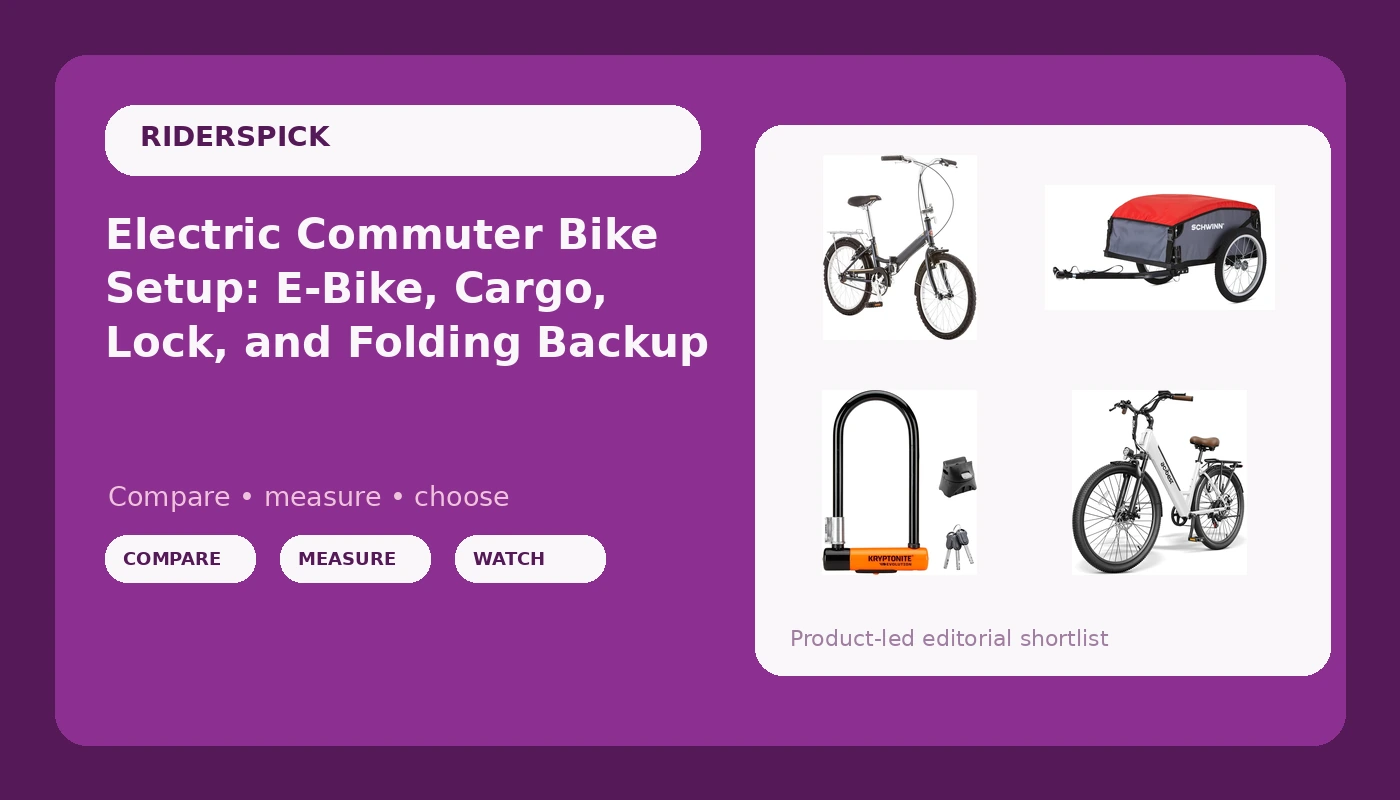
Most people shopping for an electric commuter bike setup start with the bike and stop there. They compare motors, batteries, and range claims for a week, buy the one with the biggest number on the listing, and then meet the real problems on the first Monday: nowhere to put a laptop bag, nothing solid to lock the frame to, and no plan for the morning the battery needs to come inside and charge.
A commuter setup is a system, not a single purchase. The bike moves you, but the cargo method, the lock, and the backup plan decide whether you are still riding in month three. This explainer covers four pieces that make up that system, what each one is actually for, and where each one stops being useful. Two of them are bikes, one carries what a bike cannot, and one is the reason the other three are still there when you come back.
Related: How to Lock an E-Bike So It Is Still There Tomorrow →
Quick answer
A workable setup needs four things: an e-bike whose battery you can charge indoors, a way to carry cargo without wrecking your balance, a lock sized to the replacement cost of the bike, and a simpler second bike for the days the e-bike is charging, in the shop, or parked somewhere you would rather not leave it. The ACTBEST Electric Bike for Adults covers the motorized half with a 48V 576Wh removable battery, a peak 1200W motor, and a 7-speed drivetrain. The Schwinn Daytripper handles cargo, the Kryptonite Evolution Standard U-Lock handles security, and the Schwinn Hinge is the fallback. Treat the "up to 70 miles" figure as a manufacturer claim rather than a promise, because real range moves with rider weight, terrain, and assist level.
Four useful options
| Model | Best fit | What stands out |
|---|---|---|
| ACTBEST Electric Bike for Adults, Cores 27.5" | Riders replacing a car commute | 48V 576Wh removable battery, peak 1200W motor, 7-speed drivetrain, 27.5-inch wheels |
| Schwinn Hinge Adult Folding Bike | Mixed-mode commutes and small apartments | 20-inch wheels, folding frame, rear carry rack, carrying bag included |
| Schwinn Daytripper Bike Cargo Trailer | Groceries, gear, and bulky loads | 100 lb capacity, universal coupler, folding frame, quick-release wheels, interior D-rings |
| Kryptonite Evolution Standard Bike U-Lock | Leaving a bike locked in public | 14mm steel shackle, three keys included |
The commuter e-bike: ACTBEST Electric Bike for Adults, Cores 27.5" Electric Commuter Bike Up to 70 Miles Long Range, with Peak 1200W Motor, 48V 576Wh Removable Battery, 7-Speed City Cruiser Mountain E Bike for Commuting
The removable battery is the feature that matters most here, and not for the reason the spec sheet suggests. A pack you can carry inside means you can charge at a desk, in an apartment, or in a garage without a live outlet, and it means the battery spends cold nights indoors where lithium chemistry holds up better. It also means the pack is the single most expensive part of the bike to replace, so how you store it and where you buy it matters more than the frame color. Peak wattage describes a short burst, not sustained output, and a range claim assumes a light rider, flat ground, and low assist. Before committing to any e-bike in this class, confirm that the brakes can stop the bike plus a loaded rider, and check that the battery carries a recognized safety certification. Everything else on the bike is cosmetic by comparison.
The folding backup: Schwinn Hinge Adult Folding Bike, 20-inch Wheels, Rear Carry Rack, Carrying Bag, Multiple Colors
A backup bike sounds like a luxury until the first week the e-bike is on a charger you forgot to plug in, or in a shop waiting on a part. The Hinge also solves a problem no e-bike solves: it folds, so it can go on a bus rack, into a train car, under a desk, or into a closet in a studio apartment where a full-size bike would live on the balcony and rust. The trade-off is honest and worth stating plainly. Twenty-inch wheels roll slower and rougher than 27.5-inch wheels, the gearing is meant for short trips rather than long ones, and you will do all the work yourself. That is fine, because the job here is five miles, not twenty-five, and a bike that always works beats an e-bike that sometimes does.
The cargo hauler: Schwinn Daytripper Bike Cargo Trailer, Holds up to 100 lb, Universal Coupler, Folding Frame, Quick-Release Wheels, 16-Inch Air-Filled Tires, Interior D-Rings, Schwinn Bike Trailer for Carrying Cargo
A trailer is the cheapest way to make a normal bike do cargo-bike work. Panniers are lighter and narrower, but they top out fast and they change how the bike handles because the weight sits high and to the side. A trailer keeps the load low and behind the rear wheel, which is a more stable place for anything heavy, and the Daytripper folds down when you are not using it. Two things to plan for. First, weight changes braking distance, so leave more room on a loaded run than you would on an empty one, and check the coupler against your rear axle before you buy rather than after. Second, a trailer makes the bike wider and longer, so it changes which routes work, particularly on paths with bollards or tight turns.
The lock: Kryptonite Evolution Standard Bike U-Lock, 14mm Steel Shackle & 3 Keys
The rule that keeps this simple: the lock should cost a meaningful fraction of what the bike costs to replace, and it should be one you will actually carry. A heavy lock left at home protects nothing. A U-lock earns its place because it can wrap the frame and a rack or post in one loop, which is the part thieves target first. Two habits matter more than the lock itself. Park next to something that cannot be lifted or cut, and lock in a place that is visible rather than tucked behind a building where someone can work without being watched. If you commute on an e-bike, remember that the battery is the most valuable removable part on the bike, and a removable pack is worth locking or carrying with you.
Prices and availability may change. Product images, names, and retailer links are matched to the verified product listing. Do not state a current price, rating, stock status, or measured result without current evidence.
How to read a range claim without getting burned
Range is the number buyers anchor on and the number that means the least on its own, because it is a function of four variables: rider and cargo weight, terrain, assist level, and speed. A figure produced on flat ground with a light rider and the lowest assist setting is a best case, not an average. The same battery can produce very different distances for two riders on the same route.
The spec that travels better is watt-hours. A 48V 576Wh pack is a mid-size battery for a commuter e-bike, and watt-hours are the honest measure of how much energy you are carrying, because they do not change with how the marketing department feels about the number. Commuter consumption commonly lands somewhere between 15 and 30 watt-hours per mile depending on assist level and speed, which is why the same pack delivers a short ride at full assist and a much longer one at low assist. Hills, headwinds, cold weather, and a heavier rider all push consumption up.
There is a second number that matters just as much and rarely appears in a listing: battery health. Capacity fades with charge cycles, so a pack that starts strong can be noticeably weaker after a year or two of daily charging. That is why a removable battery is worth prioritizing. It can be charged indoors, stored at a stable temperature, and replaced on its own when it fades instead of retiring the whole bike. When you evaluate any e-bike, ask how the battery is certified, how it is replaced, and what a replacement costs before you ask how far it goes.
Why the lock, the trailer, and the backup bike belong in the same budget
Buyers tend to treat accessories as optional extras to buy later. In practice, they are the difference between a bike that replaces car trips and a bike that sits in the garage after three weeks. The math is simple: if a bike costs more than a lock, and the lock is what stands between the bike and a thief, the lock is not the optional purchase.
Cargo is the second half of that equation. Most car trips people want to replace are not commutes, they are errands, and errands mean carrying things. A trailer with a 100 lb capacity changes what a single bike trip can accomplish, whether that is a week of groceries, a bag of tools, or a piece of furniture. The e-bike makes the distance manageable, and the trailer makes the load manageable.
The backup bike covers the failure mode nobody plans for. Batteries need charging, motors need service, and locks occasionally lose. A folding bike that lives in a closet costs less than the e-bike, needs no charging, and keeps the habit intact when the primary bike is unavailable. Habit is the whole point of a commuter setup, and habits break when the only option is broken.
If you are building this from scratch, work through it in this order:
- Measure your one-way commute and double it, then decide whether that distance is realistic for the assist level you will actually use.
- Choose where the battery will charge and confirm the pack is removable before anything else.
- Match the lock to the replacement cost of the bike, not to the price of the cheapest lock on the shelf.
- Pick the cargo method based on the biggest single thing you need to carry, not the average load.
- Add a second, simpler bike if the e-bike is your only way to get to work, because single points of failure are expensive.
Practical setup notes for daily commuting
- Charge the removable pack indoors, and let it settle to room temperature before charging if it came in from the cold.
- Check tire pressure weekly on both the bike and the trailer, since underinflated tires cost range and make braking worse.
- Test your brakes with a loaded bike or trailer before you need them on a downhill commute.
- Carry the spare keys somewhere separate from the lock, and keep a record of the bike's serial number and photos.
- Store the folding bike inside and dry, since folding hinges are the parts that suffer most from weather.
Which option should you choose?
Choose the ACTBEST Electric Bike for Adults when the commute is long enough that you arrive sweaty on a normal bike and you want the battery to come inside with you. Choose the Schwinn Hinge Adult Folding Bike when you need a bike that folds into a closet, rides a train, or covers the days the e-bike is unavailable. Choose the Schwinn Daytripper Bike Cargo Trailer when your trips involve groceries, gear, or anything a backpack cannot handle. Choose the Kryptonite Evolution Standard Bike U-Lock when the bike will spend time locked in public and you want a shackle you can loop through a frame and a rack.
None of these four is a complete answer on its own, and none of them is the right pick for every rider. A short, flat commute in a city with secure indoor parking does not need a trailer or a second bike, and a rider who never leaves a bike unattended on the street does not need to spend the most on security. Build the setup around your route, your parking situation, and what you actually carry.
The bottom line
An electric commuter bike setup works when all four pieces are present: a bike with a battery you can charge indoors, a cargo method that matches your real loads, a lock that matches what the bike would cost to replace, and a fallback for the days the e-bike is out of service. The ACTBEST Cores supplies the motorized half with a removable 48V 576Wh pack and a 7-speed drivetrain, the Schwinn Daytripper turns any bike into a cargo bike up to 100 lb, the Kryptonite Evolution Standard secures it with a 14mm shackle, and the Schwinn Hinge keeps the routine alive when the battery is not. Start with the route, then let the route decide which pieces you need.