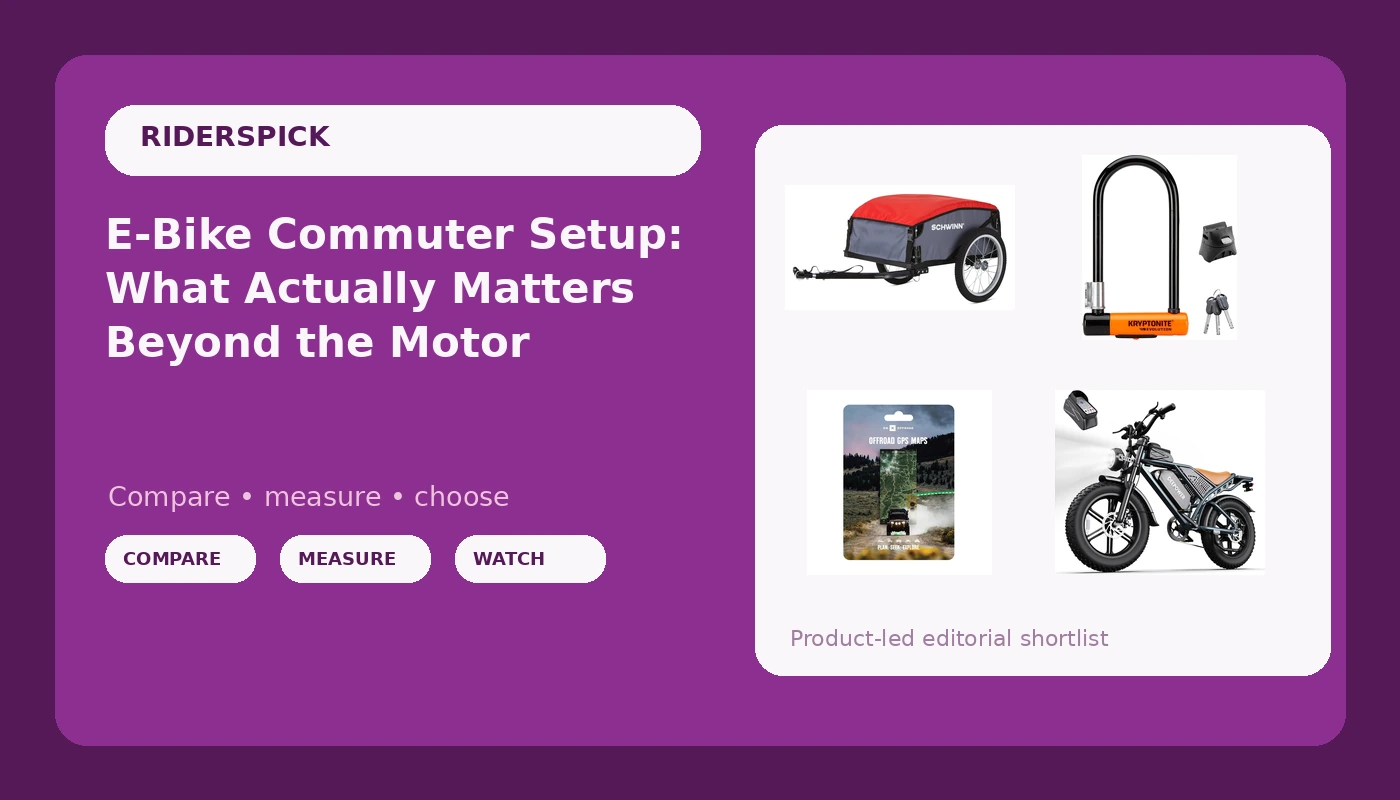
An e-bike commuter setup is not a single purchase. It is a stack of decisions about how you carry things, where the bike sits while you work, how you find a route, and what the bike itself can actually do. Most riders buy the bike, ride it for a week, and then discover the gaps: nowhere to put a laptop and a change of clothes, no lock that survives an eight-hour day in a public rack, no idea whether the range figure on the listing means anything at all. I have worked as a bike mechanic for 15 years and commuted on electric bikes for seven of them, and the same pattern shows up in nearly every setup I look at. The motor gets all the attention. The parts that decide whether the bike is genuinely useful get none. This explainer covers four pieces of an e-bike commuter setup, what each one is for, and how to decide which to add first.
Related: How to Check E-Bike Battery Health Before It Fails →
Quick answer
Fix the biggest failure point first. If the bike itself cannot handle your commute, no accessory rescues it. If you park in public, a lock is not optional. If you carry more than a backpack, cargo capacity becomes the limiting factor. If your riding leaves pavement, a route tool earns its place. The four options below map to those four roles. Read the listed specs as manufacturer claims rather than promises, verify the details that matter to you on the listing, and treat battery condition and brake quality as the two things worth walking away over.
Four useful options
| Model | Best fit | What stands out |
|---|---|---|
| Electric Bike for Adults,2000W Peak Motor,70-160 Mi Range,Moped Ebike | Riders who want the bike itself to be the long-distance platform | Listing describes a 2000W peak motor and a claimed 70-160 mile range in a moped-style frame |
| Kryptonite Evolution Standard Bike U-Lock, 14mm Steel Shackle & 3 Keys | Commuters who leave the bike in public for hours | 14mm steel shackle and three keys included |
| Schwinn Daytripper Bike Cargo Trailer, Holds up to 100 lb, Universal Coupler, Folding Frame, Quick-Release Wheels, 16-Inch Air-Filled Tires, Interior D-Rings, Schwinn Bike Trailer for Carrying Cargo | Carrying loads that outgrow a rear rack | Listed 100 lb capacity, universal coupler, folding frame, 16-inch air-filled tires |
| onX Offroad App, Nationwide Digital Trail Map Membership for Phone, Tablet & Computer, 375K+ Miles of Off-Road Trails, Open/Closed Status, Google Imagery & Offline Maps for All 50 States | Riders who mix pavement with dirt and fire roads | 375K+ miles of mapped trails with open/closed status and offline maps |
The bike: Electric Bike for Adults,2000W Peak Motor,70-160 Mi Range,Moped Ebike
The bike is the piece that sets the ceiling on everything else. A longer claimed range means fewer charging stops, but it also usually means a heavier pack, and weight changes how the bike handles at low speed and how much effort it takes to store. Before you commit to any long-range model, look for the details the headline number does not tell you: whether the battery carries a recognized safety certification, what brake type the bike uses, and whether replacement parts are findable. A bike is only as good as its weakest part, and on a commuter that weakest part is usually the battery or the brakes, not the motor.
The lock: Kryptonite Evolution Standard Bike U-Lock, 14mm Steel Shackle & 3 Keys
Locking is where commuters cut corners most often, and it is the corner that costs the most when it fails. A U-lock is heavy and awkward to carry, which is exactly why people leave it at home and rely on a cable. The trade-off is straightforward: a cable is convenient and a U-lock is not, and the inconvenience is the price of the bike still being there at 6 p.m. If you carry a heavy lock, plan where it rides so it does not swing into your leg or scratch the frame, and practice locking through the frame and a fixed object rather than around a wheel alone.
The cargo: Schwinn Daytripper Bike Cargo Trailer, Holds up to 100 lb, Universal Coupler, Folding Frame, Quick-Release Wheels, 16-Inch Air-Filled Tires, Interior D-Rings, Schwinn Bike Trailer for Carrying Cargo
A trailer changes how the bike behaves, and that is the part people underestimate. Added weight behind the rear axle lengthens stopping distance, so a loaded trailer is the strongest argument for taking brake quality seriously on the bike itself. Trailers also track differently in turns and take more room at intersections. The upside is capacity nothing else on a bicycle matches: groceries, tools, a folded stroller, or a week of laundry in one trip. If your commute is a laptop and a lunch, a rack and panniers are lighter and simpler. If it is anything more, the trailer is doing work no bag can do.
The route tool: onX Offroad App, Nationwide Digital Trail Map Membership for Phone, Tablet & Computer, 375K+ Miles of Off-Road Trails, Open/Closed Status, Google Imagery & Offline Maps for All 50 States
Route tools are the last thing most commuters buy and the first thing they want once they start exploring. A membership is a recurring commitment rather than a one-time purchase, so it makes sense if you actually ride beyond pavement often enough to use it. The open and closed status is more valuable than it sounds: gates, seasonal closures, and land access rules change constantly, and a map that knows a road is closed saves a long ride to a locked gate. Load the area you plan to ride before you leave the house, since downloading maps on the trail is not an option where there is no signal.
Prices and availability may change. Product images, names, and retailer links are matched to verified listings. No current price, rating, stock status, or measured result is stated here without current evidence.
How the four roles divide the work
The mistake in most setups is buying four versions of the same thing. These four items do genuinely different jobs, and each one fails in a different way if you skip it.
The bike is the platform. It decides how far you can go, how fast you can stop, and whether the whole system is worth maintaining. Nothing you bolt onto a bike fixes a bad battery or weak brakes.
The lock protects the investment. It is the only item on this list whose entire purpose is to prevent the loss of everything else. On an e-bike that costs more than a used car, a lock that costs less than a dinner out is a false economy.
The trailer adds capacity. It converts the bike from a commuter into a vehicle that can replace car trips. This is the piece that changes behavior most, because once you can carry 100 lb, the question of whether to drive stops being automatic.
The map app adds range in a different sense. It does not extend the battery, it extends where you are willing to point the bike. For a commuter who wants weekend dirt roads, that is the difference between a familiar loop and a new route every weekend.
What to verify on the bike itself
The bike listing carries the numbers that decide whether the other three purchases make sense. Read them in this order.
Battery certification and condition come first. A pack without a recognized safety certification is a risk you do not need to take, and capacity fades with age and with charging habits. Ask how the battery is rated and how it is replaced.
Brakes come second. An e-bike carries more weight and reaches higher speeds than a regular bicycle, so the brake type and the condition of the pads and rotors matter more, not less. A loaded trailer makes this even more important.
Motor type comes third, and it is a fit question rather than a quality question. A hub motor is simpler and works well on flat ground. A mid-drive uses the bike's gears and handles sustained climbs better. Neither is wrong; one is wrong for your terrain.
Then run the numbers on your own commute before you buy anything:
- Measure your one-way distance and double it for the round trip.
- Add a margin for detours, headwinds, and cold weather, which all reduce real range.
- Decide whether you can charge at work; if you can, range pressure drops sharply.
- Check the terrain profile of your route and whether it includes sustained climbs.
- Confirm where the bike will be stored at both ends, including weight and stairs.
Practical guidance before you spend
- Weigh the total load you actually carry, not the load you imagine carrying.
- Check whether the trailer coupler fits your bike's axle before ordering.
- Plan your lock strategy around the worst rack you will realistically use.
- Store a spare key somewhere other than the bag that rides with the bike.
- Download offline maps for any area with no cell coverage before you leave.
Which option should you choose?
Choose the Electric Bike for Adults,2000W Peak Motor,70-160 Mi Range,Moped Ebike when the bike is the missing piece and you want a long claimed range in a moped-style platform. Choose the Kryptonite Evolution Standard Bike U-Lock, 14mm Steel Shackle & 3 Keys when you already have a bike and it sits in public places for hours at a time. Choose the Schwinn Daytripper Bike Cargo Trailer, Holds up to 100 lb, Universal Coupler, Folding Frame, Quick-Release Wheels, 16-Inch Air-Filled Tires, Interior D-Rings, Schwinn Bike Trailer for Carrying Cargo when your cargo has outgrown a rack and you want to replace short car trips. Choose the onX Offroad App, Nationwide Digital Trail Map Membership for Phone, Tablet & Computer, 375K+ Miles of Off-Road Trails, Open/Closed Status, Google Imagery & Offline Maps for All 50 States when your riding regularly leaves pavement and you need routes you can trust without a signal.
One caveat applies to all four: the specs quoted here come from the product listings, not from independent measurement. Peak motor figures, claimed range, trailer capacity, and trail mileage are manufacturer statements. Verify the current details on each listing, and treat battery certification and brake quality on the bike as the two items worth refusing to compromise on.
The bottom line
A complete e-bike commuter setup answers four questions: can the bike do the distance, will it still be there when you come back, can it carry what you need, and can you find your way when the pavement ends. Buy in the order that removes your biggest failure first. For most riders that means the bike, then the lock, then cargo, then maps. Get the battery and brakes right on the bike and everything else on this list is a straightforward addition rather than a patch over a problem you should have walked away from.