Reading an e-bike listing is an exercise in separating the useful numbers from the loud ones. Peak motor watts get the biggest font. Battery capacity, the number that decides whether the bike suits your route, is often a footnote. Tire size and gearing, which decide how the bike feels at the end of a ten-mile commute, sometimes go unmentioned. And the charger, the one part you touch every day, is usually left out entirely.
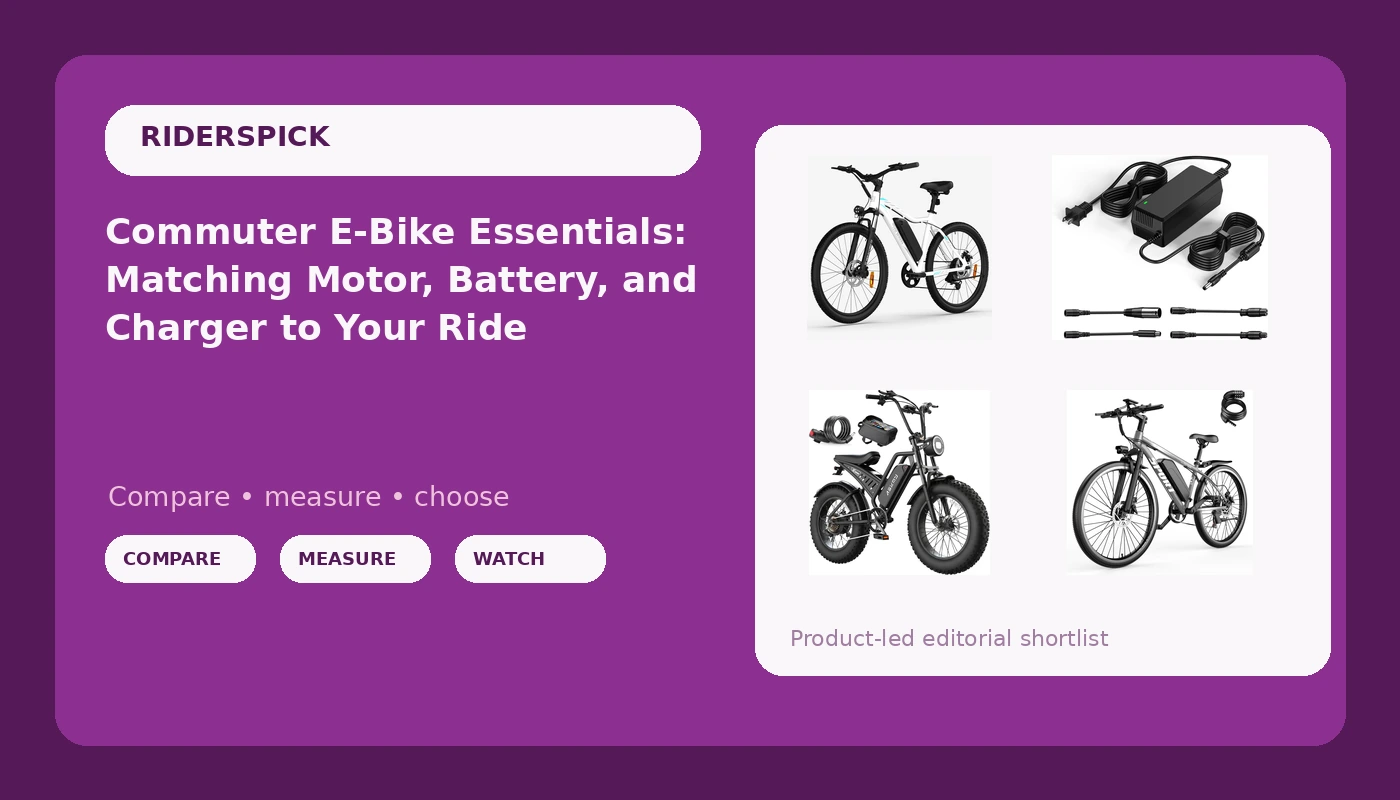
That gap is what this commuter e-bike essentials walkthrough is built to close. Four products are covered: two 26-inch e-bikes aimed at commuting and light trail use, a 20-inch fat tire model for rougher surfaces, and a 48V-compatible charger that solves the second-location charging problem. Each entry sticks to what the product record states and then names the trade-offs worth weighing before you order.
Related: How to Read an E-Bike Battery Spec Sheet →
Quick answer
For most pavement commuters, the practical default is a 26-inch e-bike with a removable battery and a 7-speed drivetrain. You can carry the pack indoors to charge, and you can still pedal home if the battery runs out. The 5TH WHEEL Mate lists the most complete commuter specification of this group, including a 468Wh removable battery, a color LCD, and an adjustable stem. The ASKGO leans toward steeper, rougher routes with a listed 1500W peak motor and 26-inch tires. The 20-inch fat tire model is the one to consider for sand, snow, and broken pavement. For owners of 48V packs from Lectric, Ecotric, or Evercross, the WUKUR charger solves charging at a second location. Whatever you choose, verify the brake system and the battery safety certification before you order, because neither is settled by a motor wattage.
Four useful options
| Model | Best fit | What stands out |
|---|---|---|
| 5TH WHEEL Mate Electric Bike for Adults, 1000W Peak Motor, 23MPH Top Speed, 468WH Removable Battery, 26 inch Commuting & Mountain E-Bike with Color LCD Display, 7-Speed Gears & Adjustable Stem Bicycle | Commuting and light trail use with indoor charging | Listed 1000W peak motor, 23 mph top speed, 468Wh removable battery, 26-inch wheels, color LCD, 7-speed gearing, adjustable stem |
| ASKGO Electric Bike for Adults, 26" Tires Mountain Ebike, 1500W Peak E-Bike | Hillier routes and rougher ground | Listed 1500W peak motor and 26-inch tires in a mountain e-bike build |
| Electric Bike for Adults, 20 Inch Fat Tire Ebike for Off Road and Commuting | Sand, snow, and uneven pavement | 20-inch fat tires with a dual off-road and commuting positioning |
| WUKUR 54.6V 2A Electric Scooter Charger 5 Connectors for 48V Lithium Batteries Compatible with Lectric XP 2.0/3.0, for Ecotric City/Beach, for Evercross H5/H7 Ebike, 8.2ft, SGS Safe Ebike Charger | A spare or travel charger for a 48V pack | 54.6V 2A output, five connector heads, 8.2 ft cable, listed compatibility with Lectric, Ecotric, and Evercross models |
The all-rounder: 5TH WHEEL Mate Electric Bike for Adults, 1000W Peak Motor, 23MPH Top Speed, 468WH Removable Battery, 26 inch Commuting & Mountain E-Bike with Color LCD Display, 7-Speed Gears & Adjustable Stem Bicycle
Two numbers deserve a slower read. First, 1000W is a peak figure, and peak figures describe brief bursts rather than what a motor holds on a long climb. Continuous ratings are usually lower, and this listing does not give one, so treat the peak number as a ceiling rather than a promise. Second, 468Wh sits at the smaller end of what commuter packs typically carry. Watt-hours are the honest measure of stored energy, and a smaller pack means a shorter distance between charges, especially at higher assist levels. If your round trip is long or hilly, plan around that rather than around the marketing.
The removable battery is the real advantage here. A pack you can carry inside means charging at a desk, in an apartment, or in a garage without running an extension cord to a rack. It also means the bike can live outside in winter while the battery lives in a heated room, which is how a lithium pack earns more useful years. Confirm the battery safety certification before ordering, since it is not stated in the product name, and check that the brakes are up to a loaded bike. At 23 mph, brakes are what stop sixty pounds of bike and rider, not the motor.
The higher-power trail pick: ASKGO Electric Bike for Adults, 26" Tires Mountain Ebike, 1500W Peak E-Bike
The same caution about peak watts applies here, only louder: a 1500W peak claim tells you what the controller can deliver in a burst, not what the motor sustains up a mile-long grade. Two other details are missing from the name and worth asking about before purchase. One is the battery capacity in watt-hours, since that decides how far the higher power can actually be used. The other is the brake type, because a heavier bike with more assist needs more stopping power, and cable discs on a 28 mph machine are a different proposition from hydraulic ones.
Where this bike makes sense is a route with real climbing or loose surfaces, the kind of ground where a 20-inch wheel feels busy and a smaller motor feels strained. Where it makes less sense is a flat, short commute, where the extra power mostly buys weight you have to push when the battery is empty. Check local trail rules as well, because many trail systems restrict where electric bikes may be ridden regardless of motor size.
The fat-tire option: Electric Bike for Adults, 20 Inch Fat Tire Ebike for Off Road and Commuting
Fat tires are a trade, not an upgrade. The wider contact patch floats over loose ground and soaks up vibration, and it also drags more on smooth asphalt, so the same battery gets you less distance on pavement than a narrower tire would. Low-pressure tires also feel vague in fast corners until you learn them. If your commute is clean pavement door to door, this is the wrong end of the category. If it includes gravel, packed sand, or a winter of unplowed side streets, it is the right one.
Because the product name is short on numbers, ask the seller for the motor rating, the battery capacity in watt-hours, and the battery certification before you commit. Those three answers decide whether the bike suits a five-mile or a twenty-mile round trip, and they are exactly the details a minimal listing tends to leave out.
The support item: WUKUR 54.6V 2A Electric Scooter Charger 5 Connectors for 48V Lithium Batteries Compatible with Lectric XP 2.0/3.0, for Ecotric City/Beach, for Evercross H5/H7 Ebike, 8.2ft, SGS Safe Ebike Charger
Voltage matching is the whole game with chargers. A 48V lithium pack is typically built from thirteen cells in series, and 54.6V is the full-charge voltage that pack reaches, which is why a 48V charger is labeled 54.6V. The voltage has to match the pack exactly. A charger built for 36V or 52V packs is not interchangeable, and the wrong output can damage cells or worse. Match the voltage first, then match the physical connector, then check the polarity of that connector against your bike's charge port.
At 2A, this is a modest charge rate, so a full charge takes hours rather than minutes. That is fine for an overnight or office charge and it is gentler on the pack than a fast charger. Two practical notes: do not charge a frozen pack, and do not charge unattended on a flammable surface. A second charger is genuinely useful, but it is not a place to save money by ignoring the voltage label.
Prices and availability may change. Product images, names, and retailer links must be matched by verified ASIN. Do not state a current price, rating, stock status, or measured result without current evidence.
What peak watts, watt-hours, and tire size actually mean
Peak watts describe the maximum the controller will feed the motor for a short burst, usually during acceleration or a steep pitch. Continuous watts describe what the motor can hold, and continuous is the number that decides whether a climb feels easy or strained. When a listing gives only a peak figure, assume the continuous rating is meaningfully lower.
Watt-hours are the honest measure of stored energy, calculated as volts multiplied by amp-hours. A 468Wh pack and a 720Wh pack can share the same voltage and still deliver very different distances. Range itself depends on rider weight, terrain, assist level, temperature, and tire pressure, which is why a single range number on a box is close to meaningless. Any figure measured with a light rider on flat ground in warm weather tells you little about a loaded commuter in January.
Wheel and tire size set the character of the ride. Larger diameter wheels roll over obstacles with less drama. Wider tires add float and cushioning and cost you efficiency on smooth pavement. Motor placement matters too: a hub motor in the wheel is simpler and cheaper and works well on flat ground, while a mid-drive at the pedals uses the bike's gears and climbs better. Nothing about a brand name changes those physics.
A five-step way to choose
- Measure your real round trip in miles, including the detour you actually take, and note the steepest hill on it.
- Decide whether the battery must be removable, which it usually must be if you park outside or live above the ground floor.
- Match tire size to your surface: 26-inch for pavement and light trail, fat tires for sand, snow, and broken ground.
- Check the brakes and the battery safety certification before you look at the motor rating, because those two decide whether the bike is safe to ride.
- Budget for the parts that are not in the box: a lock, lights, and often a second charger for the office.
Charging, storage, and daily care
- Match charger voltage to pack voltage exactly, and confirm the connector and polarity before the first charge.
- Store the pack at room temperature and around half charge if the bike will sit for weeks, not at full and not empty.
- Check tire pressure weekly. Soft tires are the most common hidden cause of short range.
- Inspect brake pads and cables monthly. The extra weight and speed of an e-bike wears pads faster than a pedal bike does.
- Never charge a frozen, wet, or damaged pack, and never leave a charging battery on a flammable surface unattended.
Which option should you choose?
Choose the 5TH WHEEL Mate Electric Bike for Adults, 1000W Peak Motor, 23MPH Top Speed, 468WH Removable Battery, 26 inch Commuting & Mountain E-Bike with Color LCD Display, 7-Speed Gears & Adjustable Stem Bicycle when your commute is pavement and light trail, you need to carry the pack indoors to charge, and you want the drivetrain and display details spelled out before you buy. Choose the ASKGO Electric Bike for Adults, 26" Tires Mountain Ebike, 1500W Peak E-Bike when your route has real climbing or rough ground and the higher peak power figure matters more to you than a documented battery capacity. Choose the Electric Bike for Adults, 20 Inch Fat Tire Ebike for Off Road and Commuting when sand, snow, gravel, or badly broken pavement is part of the ride and you accept the efficiency cost on smooth asphalt. Choose the WUKUR 54.6V 2A Electric Scooter Charger 5 Connectors for 48V Lithium Batteries Compatible with Lectric XP 2.0/3.0, for Ecotric City/Beach, for Evercross H5/H7 Ebike, 8.2ft, SGS Safe Ebike Charger when you already own a 48V pack, the voltage matches, and you want a second charge point at work or a travel charger for the car.
One caveat applies to all four. These records do not state a battery safety certification or a continuous motor rating, and none of them states a real-world range figure. Range and top speed depend on rider weight, terrain, assist level, and temperature, so treat every number above as a manufacturer claim to verify rather than a measured result. Ask the seller for the certification and the continuous rating, and if the answer is vague, keep looking.
The bottom line
The commuter decision comes down to three questions: can you charge the pack where you park, do the tires match your surface, and will the brakes stop the loaded bike. The 5TH WHEEL Mate answers those questions most completely on paper, with a removable 468Wh battery, 26-inch wheels, and a documented 7-speed drivetrain. The ASKGO trades documentation for a higher peak power figure and a mountain build. The 20-inch fat tire model is the specialist for loose ground. And the WUKUR charger is the small, unglamorous purchase that makes a 48V commuter practical, provided the voltage and connector match. Buy the battery and brakes first, the motor second, and everything else after.