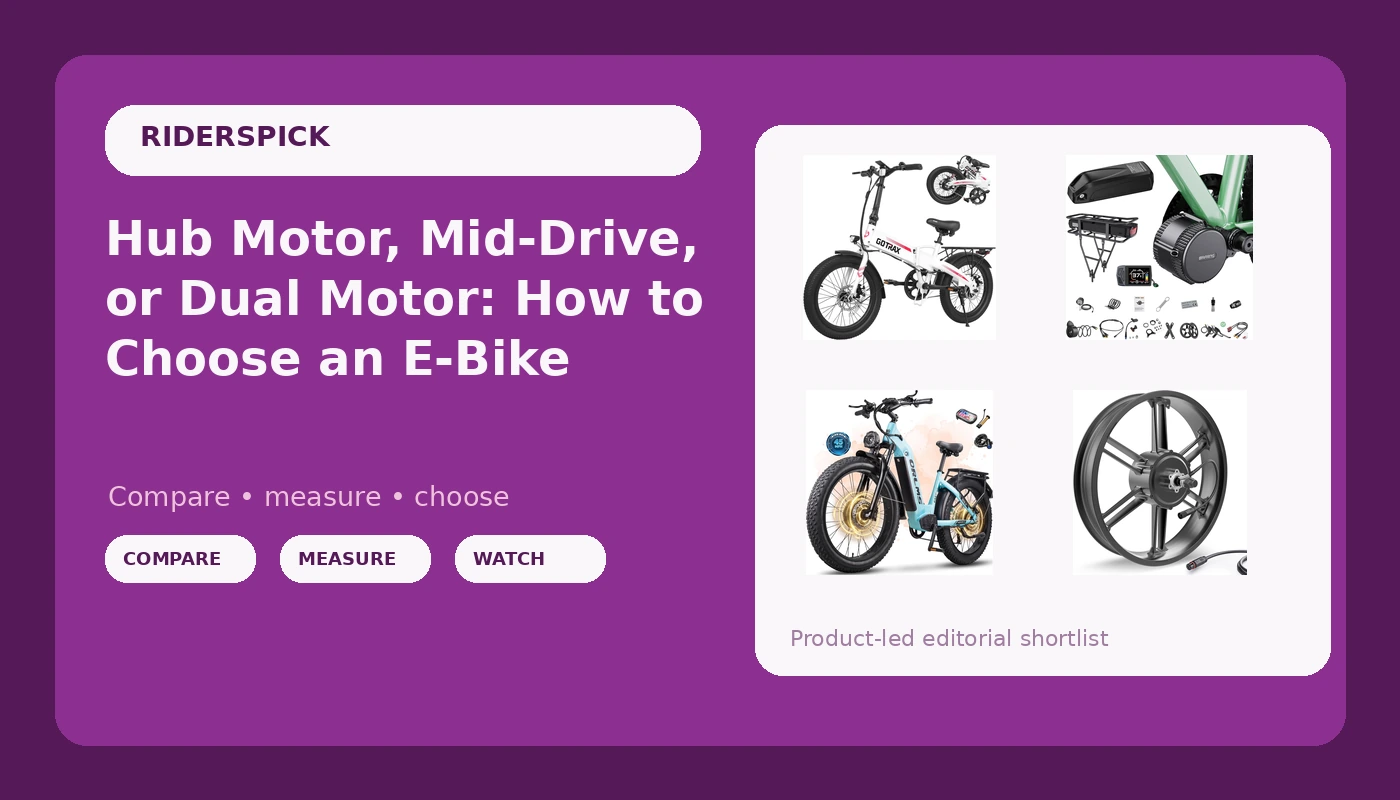
Most shoppers start with the wrong question. They ask which e-bike is best instead of asking what kind of motor they need, where the battery lives, and whether the bike has to be assembled from parts. The four electric bike motor options below cover the whole spread: a folding bike that arrives complete, a mid-drive conversion kit, a dual-motor fat-tire bike, and a single rear wheel with a hub motor already laced in. Each one solves a different problem. Mixing them up is how people end up with a 60-pound bike they cannot carry up the stairs, or a box of parts they never finish installing.
Related: E-Bike Battery Safety: What UL Certification Actually Means →
Quick answer
For most riders, a complete bike is the right call, because the battery, controller, motor, and brakes come from one seller with one warranty. A conversion kit only makes sense if you already own a frame you like and you are comfortable doing the mechanical work yourself. The decision is about how much of the bike you want to build, not how much power you can buy.
Four useful options
| Model | Best fit | What stands out |
|---|---|---|
| Gotrax R1 20" Folding Electric Bike for Adults | Riders who want a complete bike that stores small | Folding frame, 20-inch wheels, listed 40-mile range and 20 mph top speed |
| BAFANG BBS02B Mid Drive Electric Bike Conversion Kit | Riders converting a bike they already own | Mid-drive motor mounted at the pedals, offered in 500W, 750W, and 1000W versions |
| MENORX 8000W Dual Motor Electric Bike for Adults | Riders who want high power in a finished bike | Dual motors, 52V 26Ah removable battery, 26-inch fat tires, listed 45 mph |
| 20 x 4.0'' Fat Tire E-bike Rear Wheel, 48V 1000W Motor | Riders replacing or upgrading a single wheel | Hub motor built into a 20 x 4.0 fat tire with mag wheels |
Complete bike that folds: Gotrax R1 20" Folding Electric Bike for Adults
The trade-off is wheel size. Twenty-inch wheels roll over rough pavement less smoothly than larger ones, and a folding hinge is one more part to check for play every few months. A 40-mile figure is also a best case: it assumes a light rider, flat ground, and the lowest assist setting. Treat it as a ceiling, not a commute plan. If your round trip is 20 miles, this class of bike can do it, but you will be charging most days, and the assist level you actually use is what decides how much range is left at the end.
The mid-drive route: BAFANG BBS02B BBS-HD 500W 750W 1000W Mid Drive Electric Bike Conversion Kit
This is the option that asks the most from you. Installation involves the bottom bracket, so the kit has to match your frame's bottom bracket standard, and you still need a battery and controller setup that match the motor's voltage along with the tools to do the job properly. A mid-drive also puts extra load through the chain and cassette, so plan on replacing drivetrain parts more often than you would on a stock bike. What you get in return is a bike that still feels like a bike, with the motor working through the gears rather than against them.
High power in a finished bike: MENORX 8000W Dual Motor Electric Bike for Adults
Read that 45 mph figure carefully. In most US states the three legal e-bike classes stop at 20 mph for Class 1 and Class 2 and 28 mph for Class 3, so a bike listing 45 mph is not something you can legally ride at full power on a shared path, and in some places it is not treated as an e-bike at all on paper. The 100-mile range claim is an assist-level claim as well. At low assist and a steady 15 mph, a 52V 26Ah pack can go a long way; at 45 mph it will not. Check the bike's weight before ordering if you have stairs to climb.
One wheel at a time: 20 x 4.0'' Fat Tire E-bike Rear Wheel, 48V 1000W Motor,Mag Wheels
A wheel is not a bike. You still need a compatible frame, a battery and controller that match the motor's voltage, wiring to connect them, and a way to keep the axle from spinning under torque. The upside of a hub motor in the rear wheel is simplicity: one assembly to bolt on, no chain routing changes, and nothing to adjust at the bottom bracket. The downside is that the motor cannot use your gears, so steep climbs load it directly, and a heavy hub in the rear wheel changes how the bike handles at speed.
Prices and availability may change. Product images, names, and retailer links must be matched by verified listing. Do not state a current price, rating, stock status, or measured result without current evidence.
Hub motor vs mid-drive: what actually changes
A hub motor lives in the wheel and spins it directly. It is simple, it needs no changes to your drivetrain, and it works well on flat ground at moderate speeds. A mid-drive motor sits at the pedals and sends power through the chain, so it can use the bike's gears: shift down and the motor gets the same mechanical advantage you do. That is why mid-drives handle hills and heavy loads better, and why they cost more and take more work to install. A dual-motor bike is essentially two hub motors, usually one per wheel, which adds traction and doubles the power draw. None of these designs is automatically better. The right one depends on your terrain, your willingness to turn wrenches, and how fast you actually intend to ride.
How to read a range claim
A range number is a test result, not a property of the bike. The same pack that goes 60 miles at 12 mph with light pedaling can go 20 miles at 25 mph with a heavy rider and a headwind. When a listing says up to 100 miles, that phrase is doing a lot of work. Before you compare bikes on range, run your own numbers.
- Measure your real round trip, then add a margin for detours, cold weather, and errands.
- Assume you will ride at the assist level you actually want, and cut the advertised range by at least a third.
- Compare battery capacity in watt-hours, which is volts multiplied by amp-hours, instead of trusting the mile figure.
- Check that the battery is removable, so you can charge it indoors in a dry, safe place.
- Match the brakes and tires to the speed the bike can reach, because a heavy bike at 28 mph needs far more stopping distance than a 25-pound bicycle.
Before you buy: a practical checklist
- Decide first whether you are buying a complete bike or parts, because the two paths need different skills.
- For a conversion, measure your bottom bracket and rear dropout spacing before ordering anything.
- Confirm the motor voltage and battery voltage match, and that the controller is rated for both.
- Look at the brake type, and remember that cable discs fade on long descents with a loaded bike.
- Check your local rules on speed limits, licensing, and where e-bikes are allowed before buying a 45 mph machine.
Which option should you choose?
Choose the Gotrax R1 20" Folding Electric Bike for Adults, Max 40 Miles & 20Mph Speed when you want a complete, storable bike for a moderate commute and you do not want to build anything. Choose the BAFANG BBS02B BBS-HD 500W 750W 1000W Mid Drive Electric Bike Conversion Kit when you already own a bike that fits you, you want the motor to work through the gears, and you are ready to do the installation. Choose the MENORX 8000W Dual Motor Electric Bike for Adults when you want a finished high-power bike with a large removable battery and you have checked what your state allows. Choose the 20 x 4.0'' Fat Tire E-bike Rear Wheel, 48V 1000W Motor,Mag Wheels when you only need to replace or upgrade a rear wheel on a frame you already have.
One caveat applies to all four. The specifications here come from the product listings, not from a bench test or a long-term ride, and range and speed figures in particular depend on rider weight, terrain, assist level, and temperature. Verify the details that matter to you on the current listing, especially battery certification, brake type, and the voltage and connector compatibility of any kit parts, before you order.
The bottom line
A complete bike removes the assembly problem and gives you one seller to deal with if something fails. The Gotrax R1 and the MENORX take that path at very different power levels, one built for storage and modest speeds and the other built around a much larger battery and two motors. The BAFANG kit and the fat-tire rear wheel take the other path, and they only make sense if you enjoy the work and already own a frame worth converting. Whatever you pick, the battery and the brakes deserve more of your attention than the motor's watt rating, because those are the two parts that decide whether the bike is safe and whether it still works in three years.