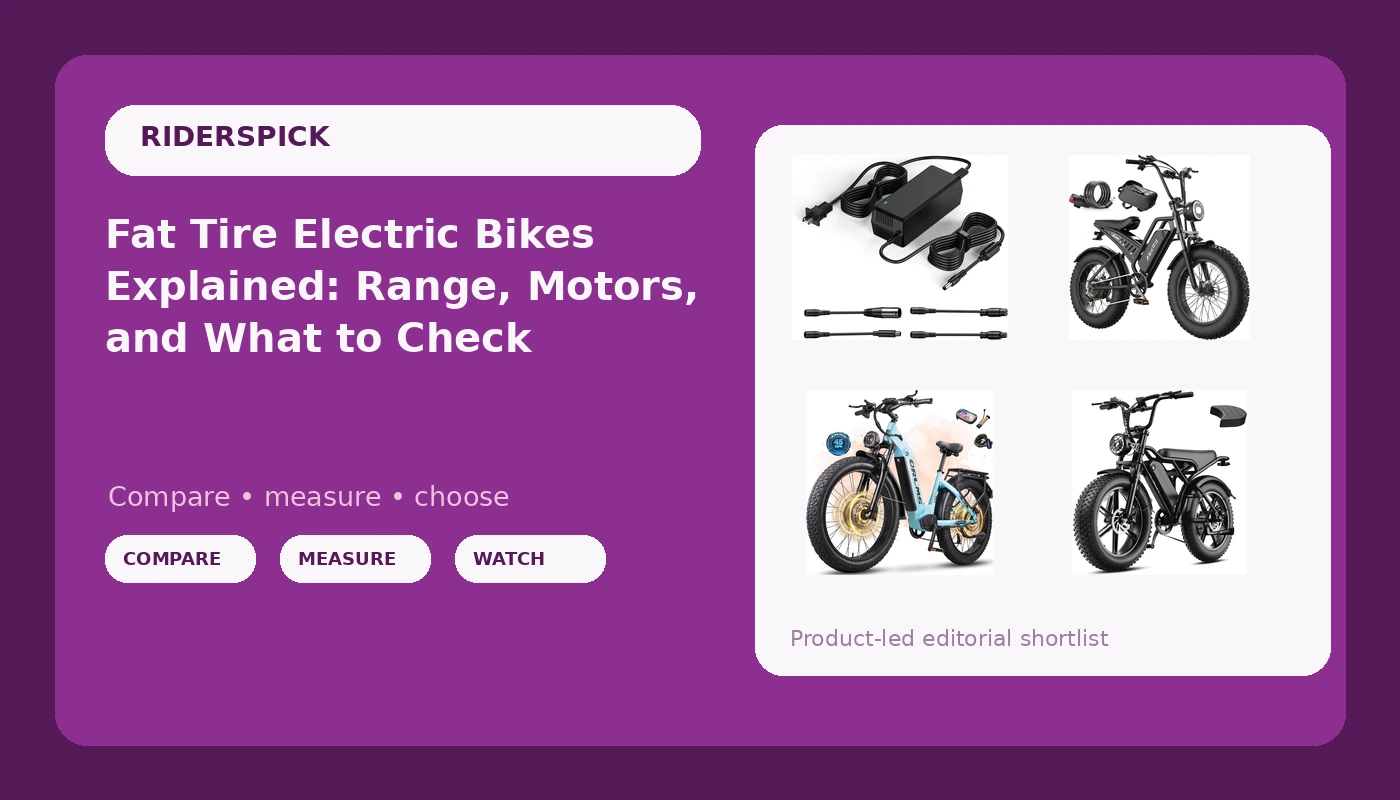
Fat tire electric bikes have moved from novelty to the default first e-bike for a lot of riders, and the listings have gotten harder to read along the way. One advertises 2,000 watts of peak power, another promises 100 miles of range, a third sells for less than a set of decent wheels, and a replacement charger costs about as much as a tune-up. None of those numbers mean what a new rider assumes they mean.
The specs that decide whether you are still riding the thing in two years, battery certification, brake quality, charger compatibility, and motor placement, are usually buried under the marketing language. This explainer walks through four listings, three fat tire electric bikes and one replacement charger, and translates each spec into something you can actually use at the checkout page.
Related: E-Bike Battery Care: How to Make a Pack Last →
Quick answer
Match the bike to the ride you actually do, not to the biggest wattage number in the search results. For most commuters, a fat tire e-bike with a verifiable battery certification, brakes rated for the bike's top speed, and a charger you can replace off the shelf will serve you longer than a higher-powered bike with an unverifiable battery. Treat wattage and range figures as claims to check, and treat battery, brakes, and charger compatibility as the deciding factors.
Four useful options
| Model | Best fit | What stands out |
|---|---|---|
| Jasion RetroVolt Electric Bike, 70-Mile Range, 2000W Peak, Fat Tire | Riders who want one fat tire bike for errands and light commuting | 2000W peak rating and a manufacturer-stated 70-mile range |
| Electric Bike for Adults, 20 Inch Fat Tire Ebike for Off Road and Commuting | Mixed surface riding where smaller wheels are easier to handle at low speed | 20 inch fat tires and a design aimed at both off road and commuting |
| MENORX 8000W Dual Motor Electric Bike for Adults, 45MPH Fast Ebike with 52V 26Ah Removable Battery, Up to 100 Miles Long Range, 26 Inch Fat Tire, Shimano 7-Speed, Shock Absorber Commuter E-Bike | Riders who want high speed and a long claimed range from a dual motor setup | Dual motor configuration, 52V 26Ah removable battery, 7-speed drivetrain |
| WUKUR 54.6V 2A Electric Scooter Charger 5 Connectors for 48V Lithium Batteries | Owners of 48V lithium systems who need a spare or replacement charger | 54.6V 2A output, five connectors, 8.2ft cable, SGS marked |
The everyday fat tire commuter: Jasion RetroVolt Electric Bike
Peak wattage is the number a controller can push for a short burst, usually on a climb or from a standstill. It is not the same as continuous output, and it says nothing about how the battery handles that draw over time. A 70-mile figure is likewise a best-case number: the same bike might return half that with a heavier rider, headwind, and full assist. What matters here is whether the battery pack carries a recognizable safety certification and whether the brakes are sized for the bike's assisted top speed. Ask the seller both questions before you order.
The smaller-wheel option: Electric Bike for Adults, 20 Inch Fat Tire Ebike for Off Road and Commuting
Smaller wheels change the ride more than the spec sheet suggests. A 20 inch fat tire rolls over curbs and gravel comfortably and keeps the bike short enough to fit in an apartment hallway or a car trunk, but the smaller contact patch and quicker steering reward attention at speed. If your commute mixes pavement, a rail trail, and a stretch of dirt, this is the geometry that makes that mix feel natural. If most of your miles are straight, fast, and paved, a larger wheel will hold a line with less effort.
The high-output build: MENORX 8000W Dual Motor Electric Bike for Adults, 45MPH Fast Ebike with 52V 26Ah Removable Battery, Up to 100 Miles Long Range, 26 Inch Fat Tire, Shimano 7-Speed, Shock Absorber Commuter E-Bike
A 45MPH claim puts this bike well beyond the 20MPH and 28MPH classes most US states regulate, so the legal question comes before the performance question. Check your state's rules on speed, motor wattage, and where a bike like this may be ridden, because a machine in this class can fall outside what counts as a bicycle. On the hardware side, a 52V 26Ah pack is genuinely large, which is where the range claim comes from, and a removable pack is a real advantage for apartment dwellers who cannot charge at street level. The trade-off is weight and price of replacement, plus the fact that 45MPH demands brakes and tires that were engineered for it, not just fitted to it.
Prices and availability may change. Product images, names, and retailer links are matched to verified listings. No current price, rating, stock status, or measured result is stated here without current evidence.
The spare charger: WUKUR 54.6V 2A Electric Scooter Charger 5 Connectors for 48V Lithium Batteries
A charger is the least exciting purchase in this article and the one most likely to end a ride. Chargers fail, get lost in moves, or get left at the office. Buying a second one is cheaper than buying a second battery. The compatibility list is the part to read closely: it names specific models, and your bike has to be on it, or at least use a matching voltage and connector. A 2A charger is a slow charger by design, so expect a long charge on a large pack, which is gentler on the cells than a fast charge and easier on a household circuit.
What the numbers on an e-bike listing actually mean
Watts, volts, and amp-hours get used interchangeably in listings, and they measure different things. Volts describe the pack's nominal pressure, so a 48V system and a 52V system are not interchangeable and cannot share a charger. Amp-hours describe capacity, so a 26Ah pack at 52V holds far more energy than a 10Ah pack at the same voltage, which is the honest source of any long range claim. Watts describe how fast the motor can convert that energy into motion, and the peak figure is a burst, not a sustained rating.
Speed classes matter just as much, and they are a legal category, not a performance one. Class 1 and Class 2 bikes are limited to 20MPH, Class 3 to 28MPH, and a bike advertising 45MPH sits outside all three. If you plan to ride on bike paths, check the local rules before you assume a fast bike is welcome there.
Charger and battery compatibility, explained
A 48V lithium pack charges to 54.6V at full, which is why a charger labeled 54.6V is the correct one for a 48V system. Get that number wrong and you either undercharge the pack or push it past its limits. Connector shape matters just as much: there is no universal plug, and the five connectors bundled with a multi-fit charger exist because manufacturers never standardized.
Three rules keep a battery alive. Never charge a pack with a charger rated for a different voltage, even if the plug fits. Never leave a pack charging unattended on a flammable surface. And never buy a replacement pack without a safety certification you can point to, because battery chemistry is not marketing, and a cheap cell is the single most expensive mistake in this hobby.
- Confirm the bike's battery voltage and match the charger's output voltage to it exactly.
- Check the charge port connector against the charger's included connector set before ordering.
- Ask the seller for the battery's safety certification, and walk away if there is no answer.
- Compare the bike's stated top speed against your state's e-bike class limits and the places you actually ride.
- Budget for a second charger and a replacement pack before you buy, not after the first one dies.
Living with a fat tire e-bike day to day
- Charge between 20 and 80 percent for daily commuting and top up to full only before a long ride.
- Store the pack indoors in moderate temperatures, not in a freezing garage or a hot car.
- Check brake pad wear every few hundred miles, since an e-bike carries more momentum than a standard bike.
- Keep tires at the pressure printed on the sidewall, because low pressure on a heavy bike accelerates both tire and rim wear.
- Note your real range at each assist level on your actual commute, and treat that number as the truth instead of the listing.
Which option should you choose?
Choose the Jasion RetroVolt Electric Bike when you want a single fat tire bike for errands and moderate commuting and you can verify the battery certification and brake spec with the seller. Choose the Electric Bike for Adults, 20 Inch Fat Tire Ebike when your riding mixes pavement, trail, and gravel and you need something compact enough to store indoors. Choose the MENORX 8000W Dual Motor Electric Bike when you want the largest stated battery and the highest stated output in this group and you have already checked that your state and your routes allow it. Choose the WUKUR 54.6V 2A Electric Scooter Charger when you own a 48V lithium bike or scooter and want a spare charger with a connector set that matches your port.
One caveat applies to all four: the performance figures here come from manufacturer listings, not from independent measurement. Range and top speed vary with rider weight, terrain, assist level, and battery health, and no listing number replaces your own testing on your own route.
The bottom line
Fat tire electric bikes are a reasonable choice for commuting and mixed surface riding, and the four listings here cover the range from a compact 20 inch all-rounder to a dual motor machine with a very large pack, plus the replacement charger every owner eventually needs. Compare them on battery certification, brake capability, charger compatibility, and legal speed class first. Wattage and range are the last numbers to weigh, not the first, and any figure that sounds too good for a 60 pound bike plus rider deserves a second look before you spend.