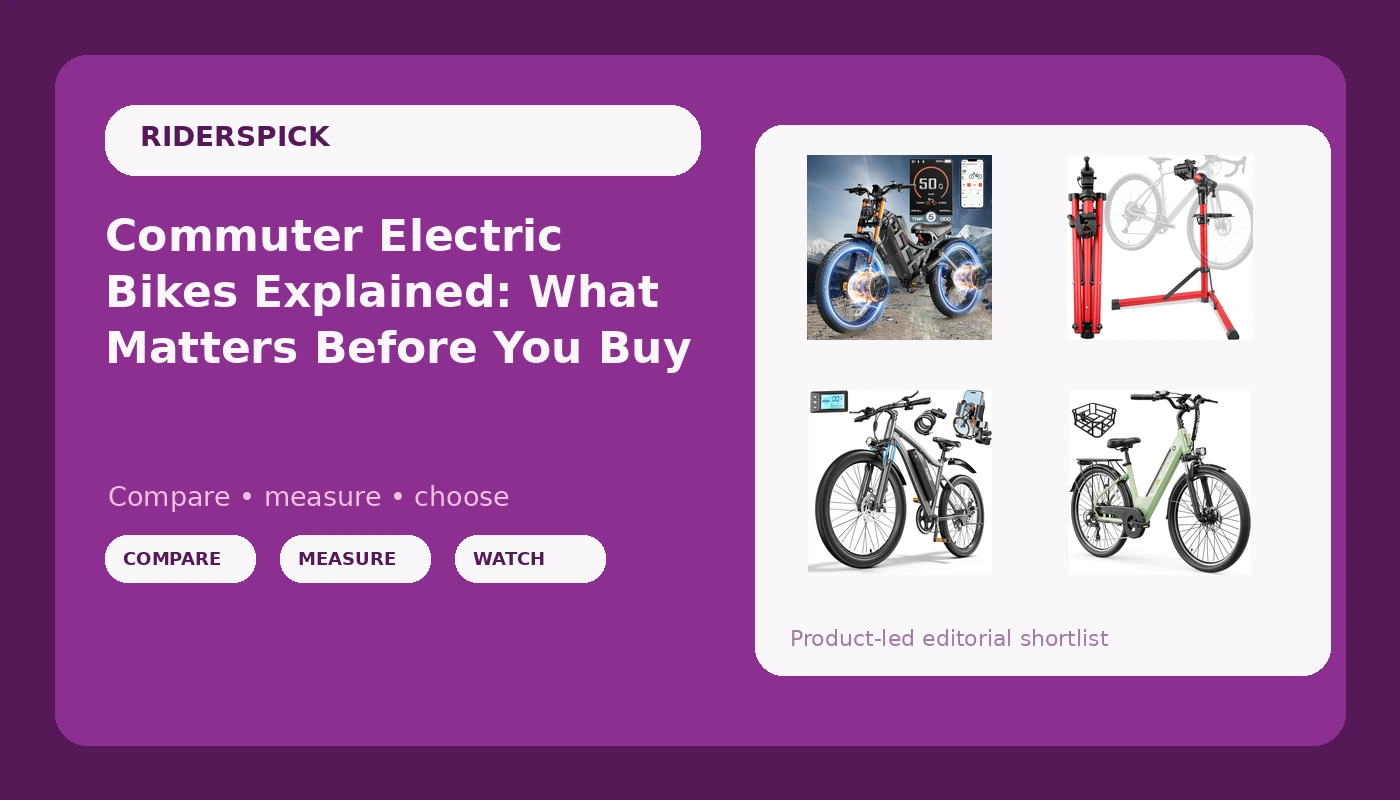
A commuter electric bike is a transportation tool, not a toy, and the spec sheet does not always tell you which one will still be rolling in three years. Most buyers start with the range claim and the top speed, then find out later that the parts deciding whether a bike survives a daily commute are the battery cells, the brake system, and whether anyone can service the thing when it finally breaks. This explainer walks through four products that sit at very different points on that map: two commuter electric bikes at opposite ends of the price range, one long-range dual-motor machine, and the repair stand that makes at-home maintenance realistic for a 60 pound bike.
Related: How to Check E-Bike Battery Health Before It Fails →
Quick answer
For a daily commute of roughly 10 miles or less on mostly flat pavement, a lighter commuter e-bike with a removable, certified battery and a 7-speed drivetrain covers the job without extra weight you will never use. For longer distances, hills, or mixed terrain, battery capacity in watt-hours and the quality of the brakes matter far more than a peak wattage number. The dual-motor fat-tire option here is built for riders who genuinely need all-terrain capability and very high claimed range. Whichever bike you pick, a repair stand rated for e-bike weight pays for itself the first time you true a wheel or swap brake pads yourself. Judge none of these listings on claimed range alone, because real range depends on rider weight, terrain, and assist level.
4 useful options
| Model | Best fit | What stands out |
|---|---|---|
| Jasion Roamer/ST Electric Bike for Adults, 26'' Commuter Ebike | Daily pavement commuting | Step-thru frame, removable 528WH battery, UL2849 certification listed |
| 2025 eAhora Romeo Pro 3 Electric Bike for Adults | Long distance and rough terrain | Dual motor, 60V 80Ah battery, 26 x 4.0 inch fat tires, full suspension, app control |
| Electric Bike for Adults, 26" Commuter Ebikes with 5-Level Pedal Assist | A first e-bike on a tight budget | 720W motor, 375Wh battery, 7-speed gears, lockable suspension fork |
| GOEHNER's Upgrade 2.0 Bike Repair Stand | Home maintenance on heavy e-bikes | 110 lb capacity, 360 degree clamp head, portable aluminum frame |
Daily commuter: Jasion Roamer/ST Electric Bike for Adults
The case for this one is the removable battery and the certification line. A battery you can carry inside is a battery you can charge at a desk, store at room temperature instead of in a freezing garage, and replace later without scrapping the whole bike. UL 2849 covers the complete electrical system rather than just the cells, which is the certification that separates a legitimate e-bike from a fire risk. The step-thru frame matters more than it sounds, because swinging a leg over a loaded commuter with a rack bag gets old fast. The trade-offs are the usual hub-motor ones. A 1200W figure describes peak output, not climbing ability, and a heavy hub bike is not enjoyable to pedal home with a dead pack. Treat the 62 mile claim as a best-case number produced under conditions you do not ride in.
Long range and all terrain: 2025 eAhora Romeo Pro 3 Electric Bike for Adults
Start with the battery math, because it explains everything else. A 60V 80Ah pack works out to 4,800 watt-hours, which is roughly ten times the capacity of a typical commuter pack, and that is where the 235 mile claim comes from. That much battery is heavy, and weight is the detail fat-tire dual-motor listings tend to whisper. The speed number deserves an even harder look. A 50MPH top speed sits well outside the legal definition of an e-bike in most US states, where Class 3 assist stops at 28MPH, so check your local rules before you treat this as a commuter. On washboard gravel and long fire-road rides, full suspension and 4 inch tires make obvious sense. On a flat four mile ride to an office, they are a lot of mass to push and a lot of bike to store.
Budget entry point: Electric Bike for Adults, 26" Commuter Ebikes with 5-Level Pedal Assist
The arithmetic matters more here than anywhere else in this group. Before you buy, take the watt-hours and divide by your own consumption, which typically lands somewhere between 15 and 30 watt-hours per mile depending on assist level, rider weight, and terrain. A 375Wh pack is the smallest here, so plan on shorter stretches between charges and size the bike against the shortest version of your commute rather than the longest. The 7-speed drivetrain and 5 assist levels are the right features at this price point, and a lockable suspension fork is a small but real benefit on broken pavement. What you give up is headroom: less battery, less motor, and fewer of the margins that make a bike pleasant to live with at 25MPH. If your round trip is short and flat, that trade is reasonable. If it is not, it is not.
Maintenance: GOEHNER's Upgrade 2.0 Bike Repair Stand
E-bikes wear faster than pedal bikes. More weight, more speed, and more torque running through the same chains, pads, and tires means more frequent service, and most of that service is simple enough to do at home. A stand turns it into a twenty minute job instead of a shop visit. The capacity rating is the spec to check first, and 110 lb is the number that makes this stand relevant to the bikes above rather than to a 25 pound road bike. A 360 degree clamp head lets you rotate the frame to reach a brake caliper or spin a wheel to check for a wobble, which is how you catch a loose spoke before it becomes a walk home. It is not a bike, but it is the purchase that keeps the other three running.
Prices and availability may change. Product images, names, and retailer links must be matched by verified ASIN. Do not state a current price, rating, stock status, or measured result without current evidence.
What actually matters on a commuter electric bike
Four things decide whether a commuter e-bike works for you, and none of them is the top speed on the box.
Battery capacity in watt-hours. Volts multiplied by amp-hours gives you watt-hours, and watt-hours are what you actually pay for. A 528WH pack and a 4,800WH pack are not in the same category of machine. Removable batteries add flexibility, since you can charge indoors at room temperature and store the pack somewhere that is not a freezing garage, both of which extend battery life.
Certification. UL 2849 covers the complete electrical system of an e-bike, and UL 2271 covers the battery itself. A listing that names a certification is giving you something to verify. A listing that says nothing about certification is telling you something too.
Motor placement. A hub motor sits in the wheel. It is simpler, cheaper, and fine for flat cities, but it cannot use the bike's gears, which is why hub bikes feel weaker on climbs than their wattage suggests. A mid-drive motor at the pedals drives through the drivetrain and climbs better, at a higher price. Peak wattage numbers are marketing; torque and gearing are what move you uphill.
Brakes. An e-bike plus rider can easily weigh 250 pounds or more, and it can travel at 28MPH. Hydraulic disc brakes offer more modulation and less hand fatigue than mechanical discs, and mechanical discs beat rim brakes. Whatever the bike has, pads and rotors are consumables, so budget for replacements.
How to read a range claim without getting fooled
Range claims are produced under one set of conditions: one rider weight, one terrain profile, one assist level, usually the lowest. Change any of the three and the number moves, often by half. Assist level is the biggest lever of all, because a motor drawing twice the power cuts your range roughly in half. The fix is not to distrust every claim but to convert it into your own numbers before you buy.
- Measure your real one-way commute distance and the total elevation gain, not the estimate you carry in your head.
- Add up everything the bike will carry: you, a bag, a lock, groceries, and a change of clothes.
- Decide the assist level you will honestly use on the worst day, then pick a battery with margin above that.
- Check whether the electrical system is certified and whether the battery is removable for indoor charging.
- Confirm the brake type, the bike's weight limit, and that the frame size and standover height actually fit you.
Practical guidance for the first year
- Charge and store the battery indoors at room temperature, and avoid leaving it at 100 percent for weeks at a time.
- Check tire pressure weekly. Underinflated tires on a heavy e-bike cost range and pinch flat easily.
- Inspect brake pads every few hundred miles, and replace them before the backing plate shows.
- Clean and lubricate the chain more often than you would on a pedal bike, because the motor puts more load through it.
- Keep the purchase receipt and confirm the warranty terms and battery replacement policy before you need them.
Which option should you choose?
Choose the Jasion Roamer/ST Electric Bike for Adults when your commute is on pavement, you want a step-thru frame you can mount with a loaded bag, and a removable battery plus listed UL2849 certification matter to you. Choose the 2025 eAhora Romeo Pro 3 Electric Bike for Adults when you ride long distances or genuinely rough terrain, you can handle a heavy machine, and you have checked your local rules on speed and classification. Choose the Electric Bike for Adults, 26" Commuter Ebikes with 5-Level Pedal Assist when your round trip is short and flat, the budget is tight, and a smaller battery is an acceptable trade for a lighter, simpler bike. Add the GOEHNER's Upgrade 2.0 Bike Repair Stand when you plan to handle your own maintenance, especially if you own more than one bike.
One caveat applies to all four: nothing here is a substitute for your own test ride and your own arithmetic. Range figures come from the manufacturer, not from a controlled test, and the only range number that matters is the one you measure on your own route at the assist level you actually use.
The bottom line
A commuter electric bike is a battery, a motor, a brake system, and a frame, in that order of importance. Watt-hours and certification come before top speed. Brakes come before styling. Fit and weight come before almost everything else, because a bike that is miserable to pedal with a dead battery is a bike that ends up in the garage. Match the machine to the commute you actually ride, verify the electrical certification before you order, and put the saved repair money toward the stand that lets you keep it running yourself.