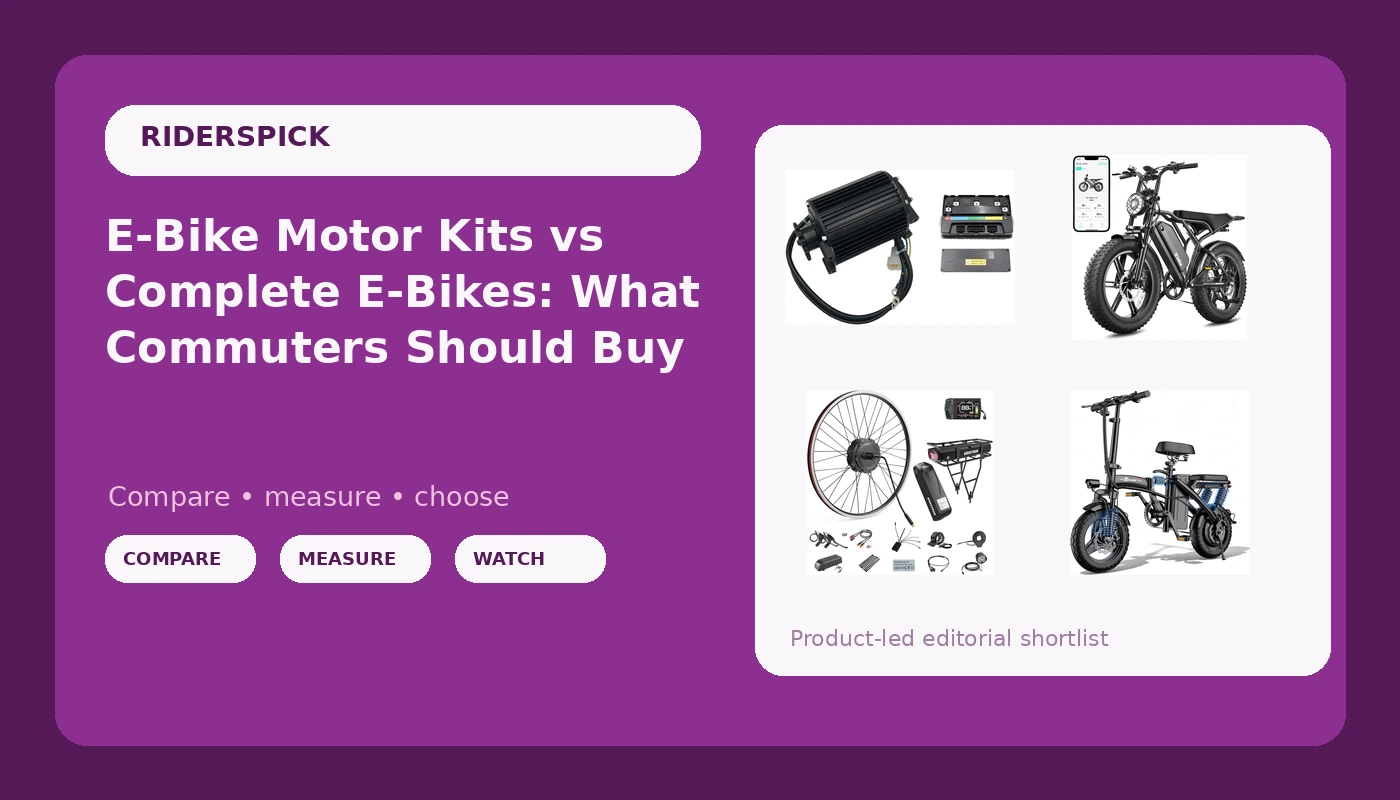
If you already own a bike you like, an e-bike motor kit can turn it electric for far less than the cost of a new ride. If you want something that works out of the box, with a battery, a charger, and a manufacturer behind it, a complete commuter e-bike is the shorter path. The choice between e-bike motor kits and commuter e-bikes is really a question about how much of the build you want to own, and how much you trust your own wrenching. This guide looks at four options: two conversion kits and two complete bikes. It covers what the numbers on a listing actually mean, where the trade-offs hide, and which route fits a daily commute versus a weekend project.
Related: Hub Motor vs Mid-Drive: Which Conversion Kit Fits Your Commute →
Quick answer
Buy a complete e-bike when your priority is a working, warrantied commuter without a project attached to it. Buy a motor kit when you already have a solid donor bike, the tools to install it, and a battery you can source and verify. Hub kits are the simpler conversion and suit flat, shorter rides. Mid-drive kits use your bike's gears and are the more capable choice for steep terrain, but a high-voltage system can push a bike outside e-bike legal limits in many places. None of the four options below is a universal answer; the right one depends on your donor bike, your hills, and your local rules.
Four useful options
| Model | Best fit | What stands out |
|---|---|---|
| Electric Bike for Adults, 1200W Peak Motor Commuting E Bike, 22/25 MPH, 30/45 Miles PAS Range, 6-Point Full Suspension Foldable Ebike, 14” Tires Electric Bicycle,Portable Electric Mini Bike | Apartment commuters who need to fold and store a bike | Listed 1200W peak motor, folding frame, 14-inch tires, 6-point suspension |
| TST Electric Bike for Adults, 48V 15Ah Battery, 1500W Peak Motor, Fat Tire | Riders who want a larger battery and fat tires from the start | Listed 48V 15Ah battery and 1500W peak motor on fat tires |
| 48V500W 750W Rear/Front Hub Motor Kit for Mountain & City Bikes | Converting a bike you already own on a small budget | Fits front or rear; listed 500W and 750W options on a 48V system |
| Mid Drive Motor 1000W 72V QS90 55KPH 3500RPM PMSM Mid Drive Motor Kits with EM50S Controller(Belt Type) | Steep terrain and riders who want the gears working with the motor | Listed 72V, 1000W, 3500 rpm, belt type with EM50S controller |
The turnkey commuter: Electric Bike for Adults, 1200W Peak Motor Commuting E Bike, 22/25 MPH, 30/45 Miles PAS Range, 6-Point Full Suspension Foldable Ebike, 14” Tires Electric Bicycle,Portable Electric Mini Bike
A complete bike removes the two hardest parts of a conversion: matching the battery to the controller, and making the frame survive the torque. What you give up is choice. The motor, the gearing, and the geometry are already decided, and a folding frame with 14-inch tires rides differently from a full-size commuter. Small wheels accelerate quickly but roll rougher over potholes and street plates, so the suspension matters more than it would on a 700c bike. Before ordering, look for the brake type and the battery certification in the listing. Those two details separate a bike that can handle a daily commute from one that belongs on short neighborhood trips.
The fat-tire option: TST Electric Bike for Adults, 48V 15Ah Battery, 1500W Peak Motor, Fat Tire
A 48V 15Ah pack works out to roughly 720 watt-hours at nominal voltage, which is a meaningful amount of energy for a bike of this class, though real range still depends on rider weight, terrain, and assist level. Fat tires add rolling resistance and weight, and they earn their keep on loose surfaces far more than on clean pavement. If your commute is mostly smooth asphalt, that extra rubber costs you range for a benefit you may never use. The 1500W figure is a peak rating, not a continuous one, so treat it as headroom for climbs and acceleration rather than a cruising number. Also check the frame size and standover height against your own measurements, since fat-tire bikes sit taller than they look in photos.
The conversion route on a budget: 48V500W 750W Rear/Front Hub Motor Kit for Mountain & City Bikes
This is the route for a rider who already likes their bike. A hub kit keeps the drivetrain stock, installs at the wheel, and usually asks less of the frame than a mid-drive. The catch is that a 48V kit needs a 48V battery and a compatible controller, and a motor kit alone does not turn your bike into a finished e-bike. Budget for the battery, a charger, and a torque arm if the kit does not include one, plus fresh brake pads or an upgraded brake set. Hub motors also add rotating weight at the wheel, which changes how the bike feels on rough roads and makes front-hub installations trickier on slick surfaces. Rear hub placement usually handles better, but check your dropout width first.
The high-voltage build: Mid Drive Motor 1000W 72V QS90 55KPH 3500RPM PMSM Mid Drive Motor Kits with EM50S Controller(Belt Type)
Mid-drive kits put the motor at the cranks, so power runs through your chain and cassette. That is why they climb well: the motor gets the same gear range your legs do. It also means faster wear on the chain, chainring, and cassette, and a 72V, 1000W system is a lot of power for bicycle drivetrain parts. A kit in this class can also move a bike out of the legal e-bike category in many US states, where the common ceiling is 750W and 28 mph. Check your state's rules and local trail policies before you build. The listing pairs the motor with an EM50S controller and a belt type drive, but confirm exactly what ships in the box, especially whether a battery, display, and mounting hardware are included.
Prices and availability may change. Product images, names, and retailer links are matched to verified listings. No current price, rating, stock status, or measured result is stated here without current evidence.
What each route actually includes
A complete e-bike is an integration purchase. The manufacturer picks the battery, the controller, the display, the brakes, and the frame together, then tests the combination and sells it with a warranty and a charger in the box. You pay for that matching work, and you accept the spec as built.
A motor kit is a component purchase. You get the motor, a controller, often a display and cabling, and mounting hardware. The battery is frequently sold separately, and the rest of the bike, including the brakes and the frame, is whatever you already own. That is the real dividing line: kits shift the compatibility work onto you.
Donor bike fit matters more than most first-time builders expect. Mid-drive kits depend on your bottom bracket standard and shell width, and they need a frame that can route the motor housing past the chainstays. Hub kits depend on dropout spacing and whether your frame has the mounts for a torque arm. Rim brakes can stop a light e-bike, but once you add a battery and a motor, disc brakes with fresh pads are the safer starting point. If your donor bike is a department-store special with a stamped steel frame, the honest answer is that the kit belongs on a better bike.
Reading the numbers before you buy
Motor ratings come in two flavors. Nominal watts describe what the motor can sustain, and peak watts describe short bursts. A listing that leads with a peak figure, such as 1200W or 1500W, is quoting headroom, not a continuous output. Neither number tells you how the bike feels on a hill, because gearing and rider input matter just as much.
Volts set the system's character. A 48V platform is the common commuter standard and pairs with a wide range of batteries and controllers. A 72V platform pushes more current through the same components and belongs in the builder category, where you should expect to verify controller limits, wiring gauge, and connector compatibility yourself.
Range figures deserve the most skepticism. A PAS range estimate assumes a light rider, flat ground, and a low assist level. Your commute has hills, stoplights, wind, and a heavier load, so plan on less. Battery capacity in watt-hours is the more useful comparison: multiply volts by amp-hours, then compare that number across bikes instead of comparing marketing mileage.
- Decide whether the battery is included, and if not, price a certified pack before you commit.
- Match voltage and connector type between the motor, controller, and battery.
- Check your state's motor wattage and speed limits, and whether a 72V build is street legal where you ride.
- Inspect the donor bike: bottom bracket, dropout spacing, brake type, and frame material.
- Confirm the box contents, the warranty terms, and the seller's return policy before ordering.
Practical guidance before you order
- Weigh the whole system, rider plus bike plus battery, against what your brakes can actually stop.
- Look for battery safety certification on the pack or the bike, and treat an uncertified pack as a hard no.
- Charge and store packs away from anything that can catch fire, and keep them out of extreme heat.
- Use a torque arm on hub motors and recheck axle nuts after the first few rides.
- Buy from a seller with a real support channel, because a failed controller is the most common early problem.
Which option should you choose?
Choose the Electric Bike for Adults, 1200W Peak Motor Commuting E Bike, 22/25 MPH, 30/45 Miles PAS Range, 6-Point Full Suspension Foldable Ebike, 14” Tires Electric Bicycle,Portable Electric Mini Bike when you need a bike that folds into a closet or a trunk and you want the battery, motor, and frame matched from day one. Choose the TST Electric Bike for Adults, 48V 15Ah Battery, 1500W Peak Motor, Fat Tire when your riding includes gravel, dirt, or winter slush and you want a larger pack without building anything. Choose the 48V500W 750W Rear/Front Hub Motor Kit for Mountain & City Bikes when you already own a bike you like, your terrain is mostly flat, and you want the lowest-cost way into electric assist. Choose the Mid Drive Motor 1000W 72V QS90 55KPH 3500RPM PMSM Mid Drive Motor Kits with EM50S Controller(Belt Type) when you have real hills, you want the motor to use your gears, and you are prepared to check the legal limits and maintain the drivetrain.
One caveat applies to all four: the descriptions here come from the listings, not from a long-term test, and none of them replaces your own check of the brake spec, the battery certification, and the local rules where you ride.
The bottom line
Complete bikes win on convenience and support, and kits win on cost and flexibility for riders who already own a good frame. A hub kit is the friendlier conversion, a mid-drive kit is the stronger climber, and a high-voltage build is a project with legal questions attached. Match the route to your terrain and your willingness to turn a wrench, verify the battery, and make sure the brakes can handle the finished weight. That combination matters more than any single number on a spec sheet.