Most shoppers start an e-bike search with a number: top speed, motor watts, or the range figure printed on the product page. The number that decides whether you keep riding is a different one. Will this thing get you to work and back for a year without a battery replacement, a brake upgrade, or a motor that quits in the rain? That question sits behind every commuter electric bike options comparison, and it explains why the four products below belong in the same conversation even though only two of them are actually e-bikes. One is a complete adult e-bike, one is a lighter geared commuter, one is a conversion kit for a bike you already own, and one is an indoor trainer for the days when the roads win. Same goal, four different answers.
Related: How to Check E-Bike Battery Health Before You Buy →
Quick answer
The right pick depends on what you already own and where you ride. If you want to ride this week with no assembly beyond handlebars and pedals, a complete e-bike is the simpler path. If you own a bike you like and the frame and brakes are sound, a 48V hub motor kit converts it for far less. If your goal is conditioning rather than transport, or you have no safe route to ride, a folding stationary bike is the honest answer. Match the motor to your terrain and the battery to your real round trip, and ignore the range sticker until you have done both.
Four useful options
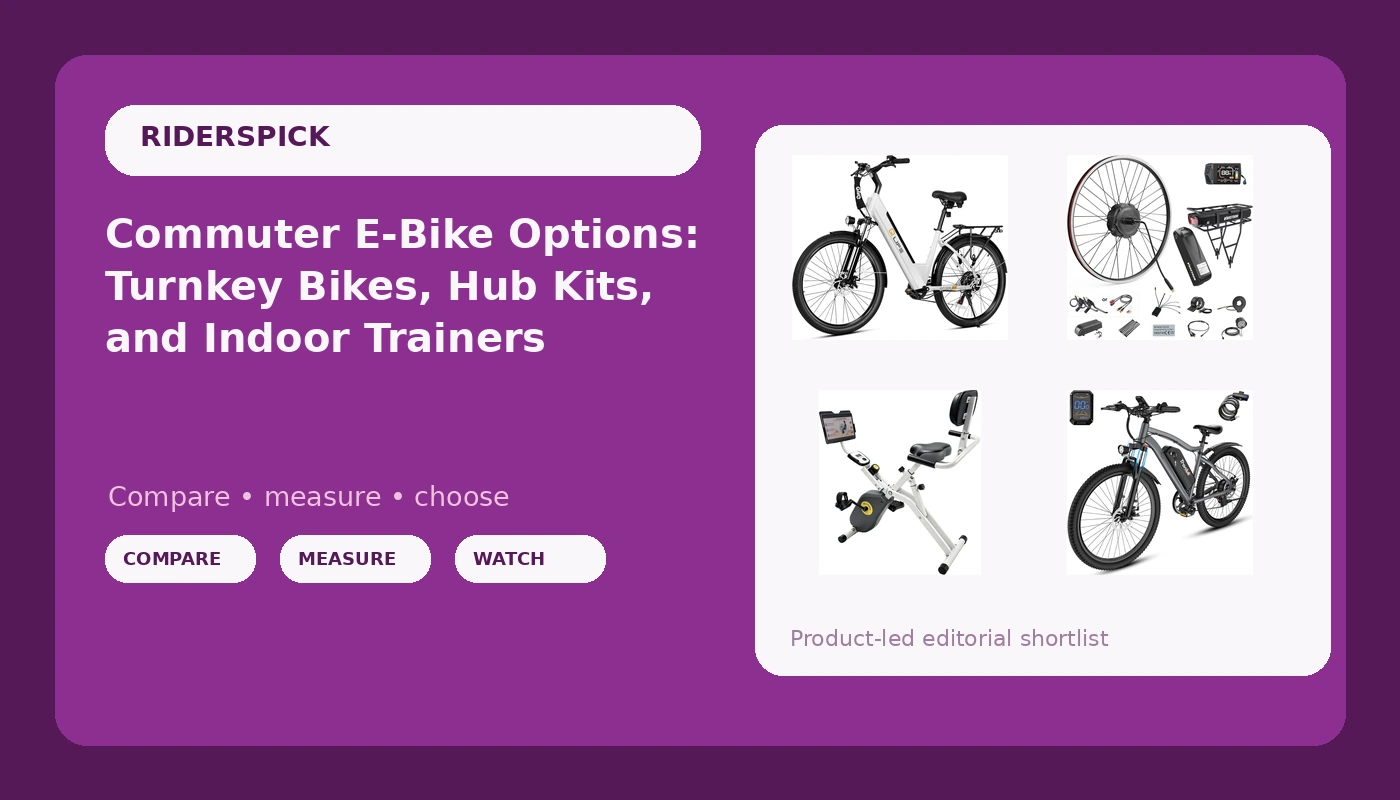
| Model | Best fit | What stands out |
|---|---|---|
| Qlife Cityone 2.0/Cityone Plus Electric Bike for Adults-1200W Peak Motor | Riders who want a complete e-bike out of the box | 1200W peak motor in a ready-to-ride adult e-bike |
| Electric Bike for Adults, 26" Commuter Ebikes with 5-Level Pedal Assist & 7-Speed Gears, 25MPH, 720W Motor, 375Wh Battery, 50 Miles, Lockable Suspension Fork, Lightweight Electric Mountain Bicycles | Commuters who want gearing and a lighter frame | 5 assist levels, 7-speed gears, 720W motor, 375Wh battery |
| 48V500W 750W Rear/Front Hub Motor Kit for Mountain & City Bikes | Owners of a bike worth keeping | 48V system in 500W or 750W, front or rear mounting |
| Foldable Magnetic Recumbent Stationary Exercise Bike | Indoor training in small spaces | Folds for storage, magnetic resistance, recumbent seat |
The turnkey option: Qlife Cityone 2.0/Cityone Plus Electric Bike for Adults-1200W Peak Motor
Peak watts describe a short burst, not sustained output, so read 1200W as an acceleration and hill-climbing number rather than a cruising number. The real questions for a turnkey bike are duller: what watt-hour battery is inside, is the pack certified by a recognized testing standard, what brakes are fitted, and does anyone sell replacement parts for this frame in two years. A complete bike wins on convenience and loses on repairability if the brand disappears. Before ordering, confirm the battery capacity in watt-hours, not amp-hours, and check that the brakes are hydraulic or at least a reputable mechanical disc setup, because a 60-pound bike and rider need more stopping power than a department store caliper delivers.
The geared commuter: Electric Bike for Adults, 26" Commuter Ebikes with 5-Level Pedal Assist & 7-Speed Gears, 25MPH, 720W Motor, 375Wh Battery, 50 Miles, Lockable Suspension Fork, Lightweight Electric Mountain Bicycles
The 375Wh pack is small next to the batteries on long-range commuters, and the 50-mile figure is a manufacturer claim that assumes a light rider, flat ground, and low assist. A 200-pound rider climbing a hill in level four will see a fraction of that. What makes this bike interesting for commuting is the gearing: seven speeds mean you can keep pedaling usefully at 20 mph instead of spinning out, and five assist levels let you dial the motor back on the flat stretches where you do not need it. The lockable fork is a small but practical detail, since a suspension fork that bobs on pavement wastes your energy. Weigh your actual round trip in miles, then halve the claimed range as a working estimate.
Prices and availability may change. Product images, names, and retailer links must be matched by verified ASIN. Do not state a current price, rating, stock status, or measured result without current evidence.
The conversion route: 48V500W 750W Rear/Front Hub Motor Kit for Mountain & City Bikes
A hub kit is the cheapest way into electric assist and the most dependent on the bike underneath it. The donor bike decides the outcome: a rear rack, a rim that can take a heavier wheel, brake mounts that can be upgraded, and a bottom bracket that is not already creaking. Rear mounting generally rides better because the weight sits over the driven wheel and the steering stays light, while front mounting is simpler to install but can feel vague on loose surfaces. If your donor bike has rim brakes, budget for a disc conversion or a different frame before you budget for the motor. The kit is also where the "motor matters more than the brand" rule bites hardest: a 750W hub motor is fine for a flat city and unpleasant on a long climb, because it cannot use your gears.
The indoor option: Foldable Magnetic Recumbent Stationary Exercise Bike
It would be easy to skip this one in a piece about commuting, and that would be a mistake. The biggest threat to a bike commute is not the bike, it is the third week in February when the routine breaks and never restarts. A folding recumbent gives you a way to keep the legs turning on the days you do not ride, and it stores in a corner instead of owning a room. Magnetic resistance is quieter and more consistent than friction, which matters if you live in an apartment. Just be clear about what it is not: there is no battery, no motor, and no throttle, so it will never replace the commute, only protect the fitness you need for it.
Battery watt-hours and brakes decide everything
Two specifications separate a bike you keep from a bike you resell in eight months. The first is battery capacity in watt-hours, which is volts multiplied by amp-hours. A 375Wh pack and a 720Wh pack can both be called "48V," and the second one goes roughly twice as far at the same assist level. Watt-hours also tell you about battery health over time: packs lose capacity with age and with every full discharge, so a bigger pack worked gently at 40 to 80 percent charge will outlast a small pack drained to zero daily. Certification matters just as much. A battery without a recognized safety certification is a chemistry experiment under your seat, not a component.
The second specification is stopping power. An e-bike carrying a 60-pound bike and a 180-pound rider at 25 mph needs disc brakes, decent pads, and a lever that does not fade on a long descent. This is the part of the spec sheet that most listings bury, and it is the part that decides whether you ride in traffic.
How to compare these four options
- Measure your real round trip in miles, then add 20 percent for detours, wind, and cold weather.
- Convert every battery you are considering into watt-hours so the comparison is honest.
- Decide whether you want a complete bike, a conversion of a bike you own, or indoor conditioning only.
- Check the brakes and the tire clearance before anything else, because those are hard to upgrade later.
- Confirm that replacement batteries and brake pads exist for the platform before you buy into it.
Practical guidance before you order
- Add up the real cost of a conversion: motor kit plus a torque arm, disc brake upgrade, and labor if you are not doing the work.
- Weigh the bike you are considering against the stairs or rack you will lift it onto every day.
- Store any e-bike battery between 40 and 80 percent charge if it will sit for weeks.
- Never charge a battery overnight in a hallway or beside a door you need for escape.
- Treat every range claim as a best case until your own commute proves otherwise.
Which option should you choose?
Choose the Qlife Cityone 2.0/Cityone Plus Electric Bike for Adults-1200W Peak Motor when you want a complete adult e-bike with a strong peak motor and no installation work. Choose the Electric Bike for Adults, 26" Commuter Ebikes with 5-Level Pedal Assist & 7-Speed Gears, 25MPH, 720W Motor, 375Wh Battery, 50 Miles, Lockable Suspension Fork, Lightweight Electric Mountain Bicycles when you want gears, five assist levels, and a lighter 26-inch bike for a shorter commute. Choose the 48V500W 750W Rear/Front Hub Motor Kit for Mountain & City Bikes when you already own a sound bike and want assist without buying a second one. Choose the Foldable Magnetic Recumbent Stationary Exercise Bike when the riding is indoors and the space is tight.
The specs discussed here come from the product names and listings, not from independent bench testing, and no range figure should be treated as verified until you ride it yourself. Battery condition at the 500-mile mark is the number that tells you whether any of these held up.
The bottom line
There is no single answer here because the products solve different problems. A turnkey bike removes the assembly and the guesswork, a geared 26-inch commuter adds range control and gearing for a shorter daily trip, a hub motor kit keeps a bike you already trust in service for a fraction of the cost, and a folding recumbent keeps you fit on the weeks the weather wins. Whichever route you take, judge it on three things: watt-hours, brakes, and whether replacement parts will exist in two years. Get those right and the range sticker stops mattering.